
Wolverine
울버린
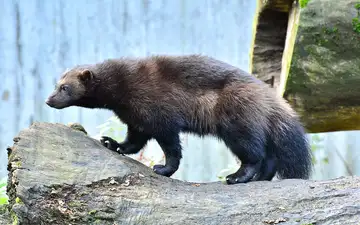
The wolverine is the largest land-dwelling member of the weasel family, a stocky, bear-like hunter. Its powerful jaws crack frozen carcasses and bones, and it ranges widely across cold forests and tundra of northern Europe, Siberia and North America.
See it on the 3D globe →At a glance
- Class
- Mammals
- Lives in
- Northern Europe, Siberia and northern North America
- Diet
- Meat eater (carnivore)
- Weight
- about 12 kg
- Length
- about 1 m
- Lifespan
- up to about 17 years
- Conservation status
- Least Concern (IUCN LC)
- Habitat
- forests, polar regions, mountains
Quick answers
Where does the Wolverine live?
It lives in forests, polar regions, mountains. On the globe you can find it near Northern Europe, Siberia and northern North America.
How big is the Wolverine?
It grows to about 1 m and 12 kg.
What does the Wolverine eat?
Its diet: meat eater (carnivore).
How long does the Wolverine live?
It can live up to about 17 years.
Is the Wolverine endangered?
It is listed as Least Concern (IUCN LC).
The wolverine is the largest land-dwelling member of the weasel family, Mustelidae. It is a muscular, bear-like hunter that lives alone. It has a reputation for fierceness out of proportion to its size and can kill animals many times larger than itself.
Wolverines live in the remote northern boreal forests, subarctic and alpine tundra of the Northern Hemisphere. The most live in northern Canada, Alaska, the Nordic countries, and western Russia and Siberia. Despite its reputation, it is also a very hardy survivor of snowy wilderness. It is a tough survivor of snowy places and covers huge areas when searching for food.
What's in a name?
Its Latin name Gulo means 'glutton'. This reputation may come partly from a false etymology, a mix-up of a Norwegian word meaning 'mountain cat' with German Vielfraß, 'devours much'.
In French Canada it is called carcajou, and in Finnish ahma. Its range once reached much farther south than it does today. The glutton reputation may come partly from a mistaken word origin, not from its real habits.
Facing change
Wolverine numbers have steadily fallen since the 19th century because of trapping, a smaller range and habitat split into pieces. They have mostly vanished from the southern ends of their old range in Europe and North America.
Its wide paws work like snowshoes, helping it travel over deep snow. It is often found in alpine tundra as well as northern forests.
Fun facts
- Its wide paws work like snowshoes, helping it travel over deep snow.
- It is the biggest land weasel.
- Its wide paws work like snowshoes.
- In Finnish it is called ahma, linked to a word for 'glutton'.
On the globe
The model shows a stocky, bear-like wolverine in a cold northern landscape.
Quiz time
Which is heavier: Wolverine or Reindeer?
Show the answer
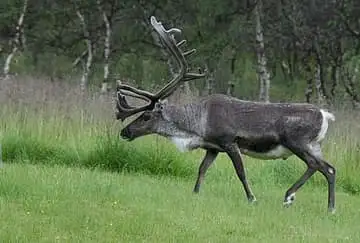
Reindeer. (12 kg vs 130 kg) Reindeer →
More like this

Sources
Updated: 2026-10-14