
Scalloped hammerhead
홍살귀상어
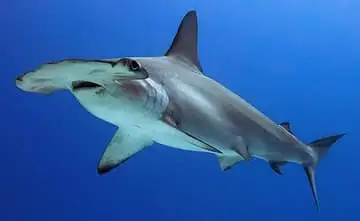
The scalloped hammerhead has an eye at each end of its hammer-shaped head, giving it a wide view. The head is also packed with sensors that detect electric fields, helping it find rays hidden in sand. By day it can gather in schools of hundreds.
See it on the 3D globe →At a glance
- Class
- Fish
- Lives in
- Eastern tropical Pacific
- Diet
- Meat eater (carnivore)
- Weight
- about 90 kg
- Length
- about 2.8 m
- Lifespan
- up to about 35 years
- Conservation status
- Critically Endangered (IUCN CR)
- Habitat
- coasts, open ocean, coral reefs
Quick answers
Where does the Scalloped hammerhead live?
It lives in coasts, open ocean, coral reefs of the Pacific, Atlantic and Indian oceans. On the globe you can find it near Eastern tropical Pacific.
How big is the Scalloped hammerhead?
It grows to about 2.8 m and 90 kg.
What does the Scalloped hammerhead eat?
Its diet: meat eater (carnivore).
How long does the Scalloped hammerhead live?
It can live up to about 35 years.
Is the Scalloped hammerhead endangered?
It is listed as Critically Endangered (IUCN CR).
The scalloped hammerhead is a shark with a flat, hammer-shaped head. Its eyes and nostrils sit at the two tips of the hammer, and the head has a dent in the middle and two more on each side, which gives it a scalloped look. It is the most common hammerhead, but it is smaller than the great and smooth hammerheads.
It lives in warm coastal seas all around the world, down to about 500 metres deep. Males are around 1.5 to 1.8 metres when grown up, and the biggest can reach about 4.3 metres. The IUCN lists the species as Critically Endangered.
A head full of sensors
The wide head gives the shark a very wide field of view. It is also packed with sensors that detect the tiny electric fields made by other animals, so it can find rays hiding in the sand.
The shark is a fast, clever hunter with a high metabolism and good senses. It eats fish, squid and rays. Its flat head also works a bit like a wing, helping it turn quickly.
Schools by day
By day, scalloped hammerheads gather in large schools around islands such as Cocos Island and the Galápagos, and at night they spread out to hunt.
They are not considered very dangerous to people, and they usually swim away when divers get close. The biggest dangers to them come from fishing. Many scalloped hammerheads live in shallow coastal water down to 25 metres, though they also dive deep. Young scalloped hammerheads often stay in sheltered shallow nurseries before heading out to deeper water.
Fun facts
- By day, scalloped hammerheads gather in large schools around islands such as Cocos and the Galápagos.
- Its eyes and nostrils sit at the tips of its hammer.
- It can sense electric fields to find hidden rays.
- It is the most common of all hammerhead sharks.
On the globe
The globe places the scalloped hammerhead in the eastern tropical Pacific. Look for the wide, hammer-shaped head.
Quiz time
Which is heavier: Scalloped hammerhead or Great barracuda?
Show the answer
Scalloped hammerhead. (90 kg vs 6 kg) Great barracuda →
More like this
_Costa_Rica_(cropped).jpg)
Sources
Updated: 2026-10-14