
Short-beaked echidna
바늘두더지
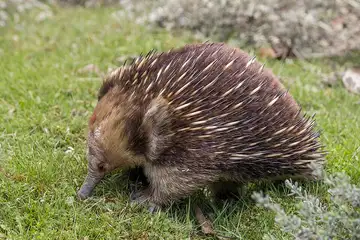
The short-beaked echidna is an egg-laying mammal covered in spines, found across Australia and New Guinea. It eats ants and termites with a long, sticky tongue and burrows or curls into a spiny ball when threatened.
See it on the 3D globe →At a glance
- Class
- Mammals
- Lives in
- Australia and New Guinea
- Diet
- Insect eater
- Weight
- about 4.5 kg
- Length
- about 0.4 m
- Conservation status
- Least Concern (IUCN LC)
- Habitat
- forests, grasslands, deserts
Quick answers
Where does the Short-beaked echidna live?
It lives in forests, grasslands, deserts. On the globe you can find it near Australia and New Guinea.
How big is the Short-beaked echidna?
It grows to about 0.4 m and 4.5 kg.
What does the Short-beaked echidna eat?
Its diet: insect eater.
Is the Short-beaked echidna endangered?
It is listed as Least Concern (IUCN LC).
The short-beaked echidna is a small, spiny mammal that lays eggs. It is one of only five living kinds of egg-laying mammals, the monotremes, which also include the platypus. It is covered in fur and spines, has a narrow snout and uses a specialised sticky tongue to catch ants and termites at great speed. The scientific name Tachyglossus means 'fast tongue'.
It is found all over Australia, where it is the most widespread native mammal, and in coastal and highland eastern New Guinea. It has no weapons, but it curls into a ball and sticks out its spines when in danger. Its front limbs and claws are so strong that it can dig itself underground quickly. It cannot sweat, so in hot weather it avoids the daytime. It is not threatened with extinction, although hunting, habitat loss and introduced predators have reduced numbers in Australia.
Eggs and a pouch
Females lay one egg a year. The solitary animals meet only to mate, and the male has no contact with the female or the young afterwards. A newborn echidna is the size of a grape and grows quickly on rich milk. By seven weeks it is too big and spiky for the pouch and is left in the mother's burrow. At about six months it leaves and has no more contact with its mother.
Senses and survival
The snout has touch and electrical sensors that help the echidna find its way. Because it must survive underground, it tolerates high carbon dioxide and low oxygen. In the Australian winter it goes into deep torpor and hibernation to save energy, and it comes out to mate when the weather warms. If it has to, it can swim. In arid places it mostly eats ants and termites, while in wetter places it eats ants and scarab beetle larvae.
Names and ancient history
George Shaw first described it in 1792 and, thinking it might be related to the giant anteater, named it Myrmecophaga aculeata. Older books call it the spiny anteater, but it is only a very distant cousin of true anteaters. The earliest fossils are about 15 million years old, and echidnas are believed to have split from the platypus about 66 million years ago. Indigenous groups have many names for it, such as nyingarn among the Noongar people.
Fun facts
- Along with the platypus, echidnas are the only mammals that lay eggs.
- It lays eggs even though it is a mammal.
- A newborn is the size of a grape.
- Its scientific name means 'fast tongue'.
- It can swim and survive in underground burrows with little oxygen.
On the globe
The model shows a spiny, snouted echidna, as in the card. Look at the long thin snout and the spines.
Quiz time
Which is heavier: Short-beaked echidna or Platypus?
Show the answer
Short-beaked echidna. (4.5 kg vs 1.4 kg) Platypus →
More like this
_Scottsdale.jpg)
Sources
Updated: 2026-10-14