
Famous landmarks in Mexico
10 landmarks · 1 animal · 2 places to discover
Mexico on My Earth Toy, the free 3D toy globe for kids: 10 landmarks, 1 animal, 2 places to discover. Here you can see its flag, capital and size, then fly to every place on the globe.
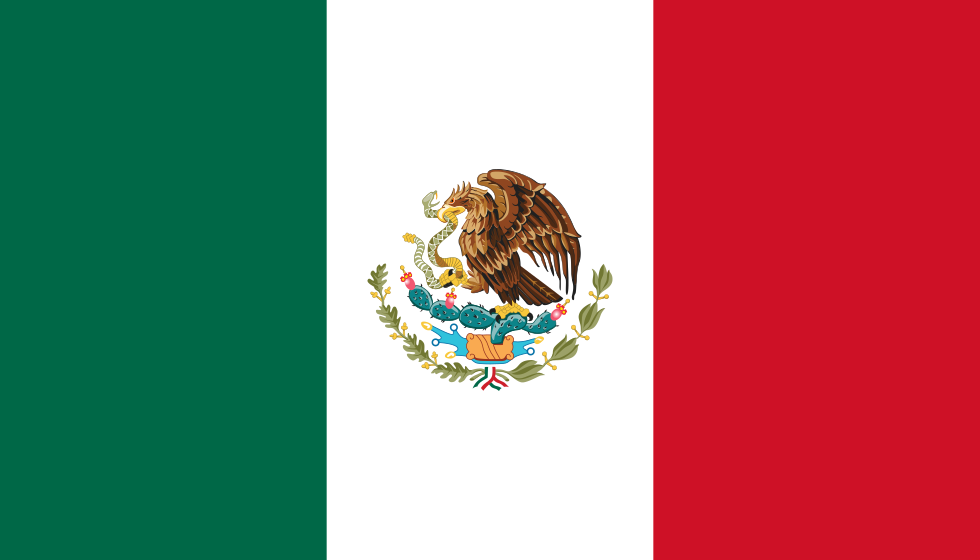
Mexico's flag has three upright stripes, green, white and red, with the national coat of arms, an eagle on a cactus eating a snake, in the white middle stripe.
Read about this flag →Mexico at a glance
- Capital
- Mexico City
- Continent
- North America
- Area
- 1,964,375 km²
- Population
- 130.9 million
Mexico is a large country in North America, between the United States to the north and Guatemala and Belize to the south, with coasts on the Pacific Ocean, the Gulf of Mexico and the Caribbean Sea. Its capital, Mexico City, is one of the biggest cities in the world. Mexico has more Spanish speakers than any other country. It is famous for ancient pyramids, colourful festivals such as the Day of the Dead, mariachi music and foods like tacos, chocolate and chilli.
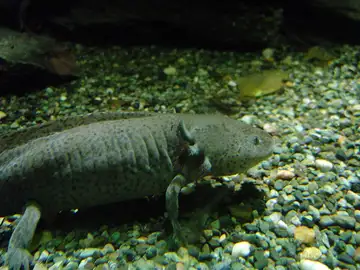
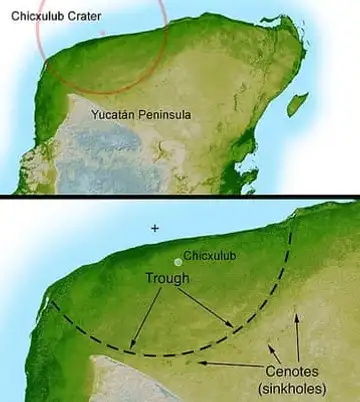
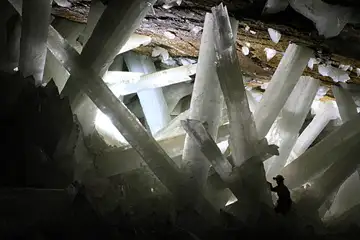
On My Earth Toy you can climb among the ruins of Chichén Itzá, Teotihuacan, Tulum and Uxmal's Pyramid of the Magician, and visit Mexico City's Templo Mayor, Metropolitan Cathedral, Palacio de Bellas Artes and Museo Soumaya. Look for the smiling axolotl, and discover the Chicxulub crater and the Cave of the Crystals.
Geography and nature
Two long mountain ranges, the Sierra Madre Occidental and Oriental, frame a high central plateau. Volcanoes rise across the middle of the country, including Pico de Orizaba, the highest peak at 5,636 metres. The north has the Sonoran and Chihuahuan deserts, and the flat Yucatán Peninsula is dotted with cenotes, natural sinkholes filled with clear water. Mexico is one of the most biodiverse countries on Earth, and millions of monarch butterflies spend each winter in its mountain forests.
People, languages and culture
Spanish is spoken by almost everyone, and Mexico also recognises dozens of Indigenous languages, such as Nahuatl and Yucatec Maya. Most Mexicans are Catholic. On the Day of the Dead, families decorate altars with marigolds, sugar skulls and photos to remember loved ones. Mariachi music and traditional Mexican cooking are both on UNESCO's heritage lists. English words such as chocolate, tomato and avocado come from Nahuatl, the language of the Aztecs.
History in a nutshell
The Olmecs built one of the earliest civilisations here about 3,000 years ago, followed by the great city of Teotihuacan and the Maya cities of the south. In 1325 the Aztecs founded Tenochtitlan on an island in a lake, where Mexico City stands today. Spanish forces led by Hernán Cortés conquered the Aztec Empire in 1521, and the region became New Spain. Mexico's war of independence began in 1810, and independence was won in 1821. The Mexican Revolution took place from 1910 to about 1920.
Fun facts
- The Chicxulub crater in Yucatán was made by the asteroid linked to the extinction of the dinosaurs 66 million years ago.
- The Cave of the Crystals holds some of the largest natural crystals ever found, some about as long as a bus.
- Axolotls can regrow lost legs and even parts of their heart.
- The Sac Actun cave system under Yucatán is one of the longest underwater caves in the world.
Famous landmarks in Mexico
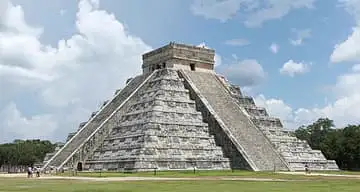
Chichén Itzá
Mexico · North America
A great Maya city whose El Castillo pyramid casts a serpent-shaped shadow at the equinoxes.
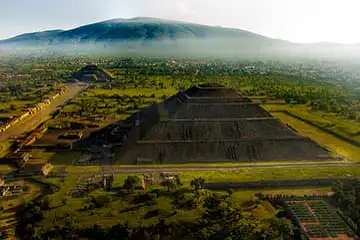
Teotihuacan
Mexico · North America
An ancient city of the Pyramids of the Sun and Moon, once among the largest cities in the Americas.
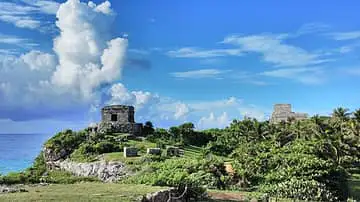
Tulum
Mexico · North America
A walled Maya port city perched on cliffs above the turquoise Caribbean Sea.
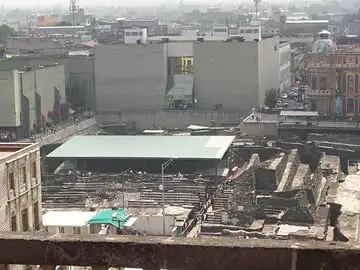
Templo Mayor
Mexico · North America
The excavated great temple of Aztec Tenochtitlan, whose twin shrines to Tláloc and Huitzilopochtli were rebuilt seven times.
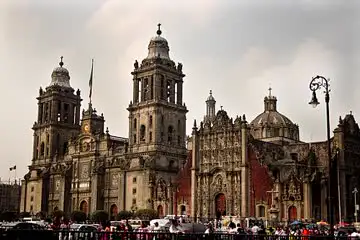
Mexico City Metropolitan Cathedral
Mexico · North America
The largest cathedral in the Americas, facing the Zócalo with two bell-capped towers beside the red-tezontle Sagrario.
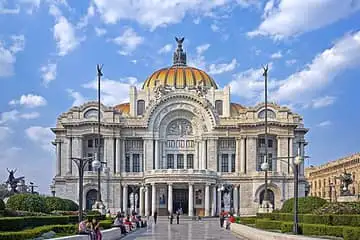
Palacio de Bellas Artes
Mexico · North America
A marble cultural palace with Art Nouveau outside and Art Deco inside, home to famous Mexican murals.
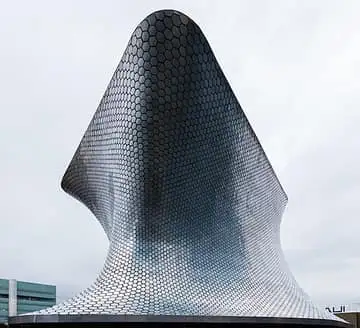
Museo Soumaya
Mexico · North America
Carlos Slim's art museum by Fernando Romero: a windowless, twisted anvil-like form that narrows at the waist, wrapped in about 16,000 hexagonal aluminium tiles.
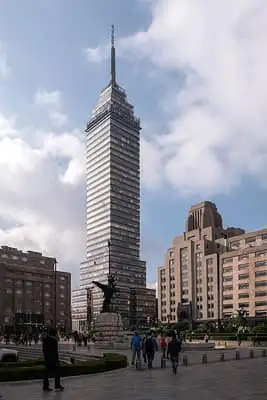
Torre Latinoamericana
Mexico · North America
Mexico's tallest building from 1956 to 1982, a glass-and-aluminium tower whose steel frame and deep piles carried it unharmed through the 1957 and 1985 earthquakes; observation decks and a lattice spire crown it.
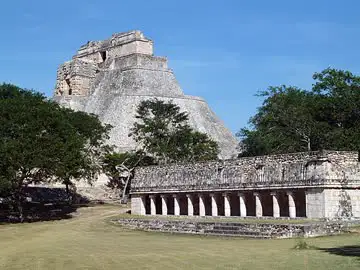
Pyramid of the Magician
Mexico · North America
A Maya pyramid with a unique oval plan and rounded ends, said in legend to have been raised by a dwarf magician in one night.
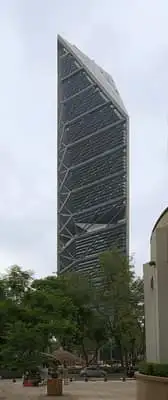
Torre Reforma
Mexico · North America
A 246 m tower shaped like an open book: two exposed-concrete walls closed by a glass front braced with steel diagonals, which gives way near the top to a huge inverted triangle of concrete.
Animals in Mexico
Places to discover in Mexico
Questions
What is the capital of Mexico?
The capital of Mexico is Mexico City.
Which continent is Mexico in?
Mexico is in North America.
How big is Mexico?
Mexico covers about 1,964,375 km².
How many people live in Mexico?
About 130.9 million people live in Mexico.
What are the most famous landmarks in Mexico?
Some of the best-known landmarks in Mexico are Chichén Itzá, Teotihuacan, Tulum, Templo Mayor and Mexico City Metropolitan Cathedral. My Earth Toy has 10 landmarks from Mexico on its free 3D globe, each with a photo and quick facts.
Which animals can you find in Mexico on My Earth Toy?
On the globe you can find Axolotl in Mexico.
Sources
Updated: 2026-10-30