
Famous landmarks in Spain
13 landmarks · 1 animal
Spain on My Earth Toy, the free 3D toy globe for kids: 13 landmarks, 1 animal. Here you can see its flag, capital and size, then fly to every place on the globe.
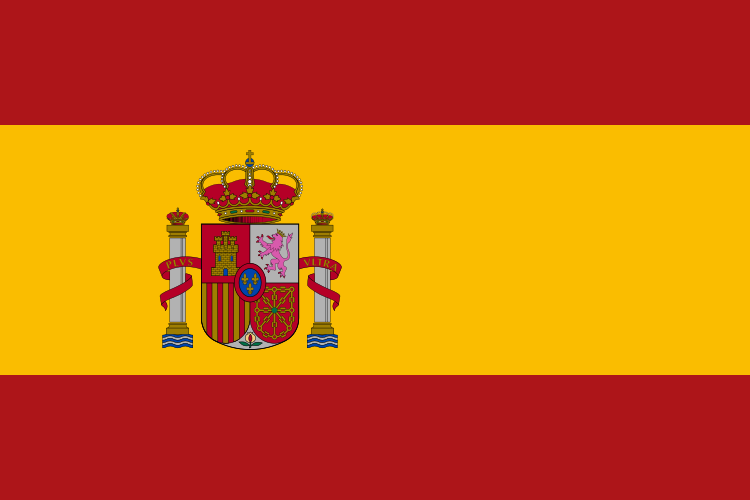
Spain's flag has three horizontal stripes, red, yellow and red. The yellow stripe is twice as tall as each red one and carries the coat of arms near the flagpole.
Read about this flag →Spain at a glance
- Capital
- Madrid
- Continent
- Europe
- Area
- 505,990 km²
- Population
- 47.9 million
Spain is a country in south-western Europe that covers most of the Iberian Peninsula. It borders France and Andorra to the north and Portugal to the west, and it has coasts on both the Mediterranean Sea and the Atlantic Ocean. It also includes the Balearic and Canary Islands. The capital, Madrid, sits almost in the middle of the country.
Spain is famous for sunshine, beaches, flamenco, tapas and amazing architecture. On the globe you can visit the Sagrada Família, the Alhambra, the Mosque-Cathedral of Córdoba, the Guggenheim Bilbao, Santiago de Compostela Cathedral, the Aqueduct of Segovia, Seville's Plaza de España and Madrid's Royal Palace, Puerta de Alcalá and Cibeles, as well as the Eurasian eagle-owl.
Geography and nature
The heart of Spain is the Meseta, a high, dry plateau crossed by mountain ranges. The Pyrenees form the border with France, and the Sierra Nevada in the south has snowy peaks. Spain's highest mountain, Mount Teide, is a volcano on the Canary island of Tenerife, about 3,715 metres tall. The north is green and rainy, while the south-east is so dry that the Tabernas area there is often called Europe's only desert. Doñana National Park shelters flamingos and the rare Iberian lynx, one of the world's most endangered wild cats.
People, languages and culture
Spanish, also called Castilian, is spoken everywhere, and some regions also have their own official languages: Catalan, Galician and Basque, which is not related to any other known language. Most people have a Catholic heritage. Spaniards often eat lunch late and dinner even later. Favourite foods include paella, potato omelette, gazpacho and small shared dishes called tapas. Flamenco, with its guitar, singing and dance, comes from Andalusia. Football is a passion, and festivals fill the streets all year.
History in a nutshell
Prehistoric people painted animals in caves such as Altamira. The Romans ruled Hispania for centuries and built the Aqueduct of Segovia. From 711, Muslim rulers governed much of the peninsula, called Al-Andalus, building wonders like Córdoba's great mosque and Granada's Alhambra. Christian kingdoms gradually took the land back, finishing in 1492, the same year Columbus sailed to the Americas. Spain then built a huge empire. In the 1900s it suffered a civil war and a long dictatorship, and it became a democracy after 1975.
Fun facts
- Work on Gaudí's Sagrada Família in Barcelona began in 1882 and has continued for well over a century.
- A plaque outside the Real Casa de Correos in Madrid marks Kilometre Zero, the point from which Spain's main roads are measured.
- The Aqueduct of Segovia was built by the Romans without any mortar holding its granite blocks together.
- Spain has some of the most UNESCO World Heritage Sites of any country in the world.
Famous landmarks in Spain
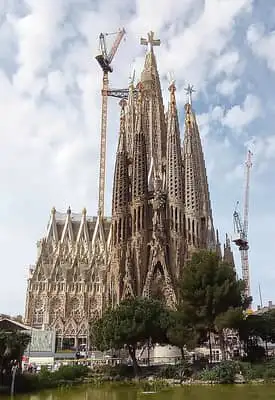
Sagrada Família
Spain · Europe
Gaudí's towering basilica, under construction since 1882 and famous for its organic, fantastical forms.
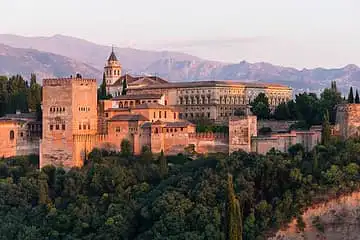
Alhambra
Spain · Europe
A Nasrid palace-fortress famed for its intricate Islamic decoration, courtyards and gardens.
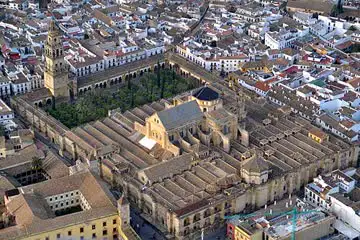
Mosque–Cathedral of Córdoba
Spain · Europe
The great mosque of Umayyad Córdoba, famed for its forest of striped arches, with a Renaissance cathedral set in its middle.
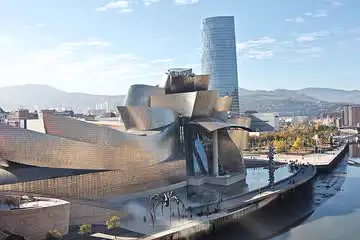
Guggenheim Museum Bilbao
Spain · Europe
Frank Gehry’s titanium-clad, curving museum that transformed Bilbao.
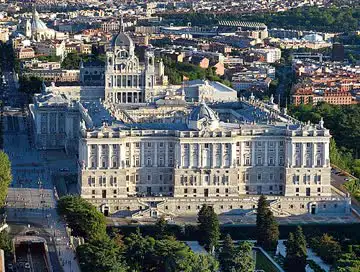
Royal Palace of Madrid
Spain · Europe
The official residence of the Spanish royal family, built in the 18th century on the site of the old Alcázar; with 3,418 rooms it is the largest palace in Western Europe.
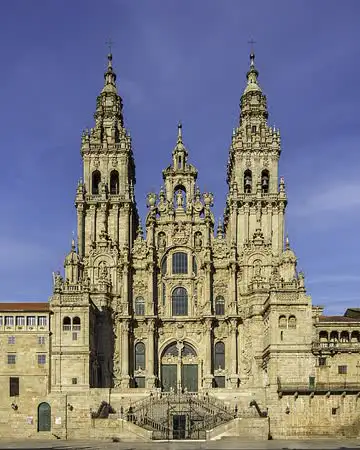
Santiago de Compostela Cathedral
Spain · Europe
The goal of the Camino de Santiago, its Baroque Obradoiro facade and twin towers facing the great square.
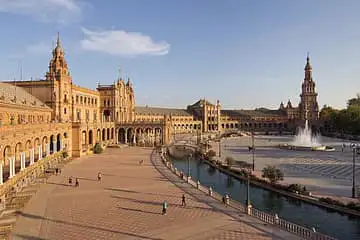
Plaza de España, Seville
Spain · Europe
A grand semicircular plaza with a canal, bridges and tiled alcoves for each Spanish province.
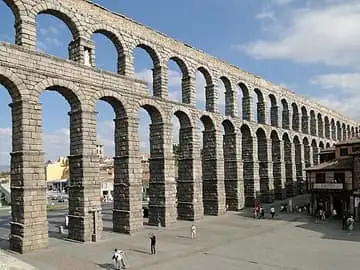
Aqueduct of Segovia
Spain · Europe
A Roman aqueduct of granite blocks laid without mortar, its two tiers of arches striding across the city.
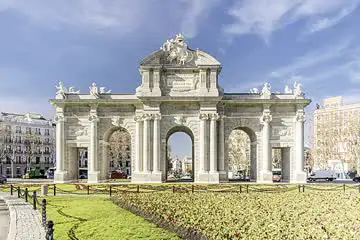
Puerta de Alcalá
Spain · Europe
A neoclassical triumphal gate completed in 1778 for King Charles III, standing in the Plaza de la Independencia beside the Retiro Park.
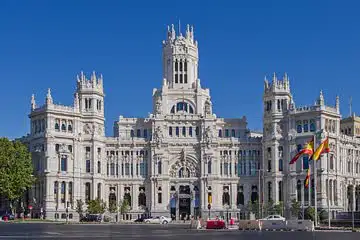
Cibeles Palace & Fountain
Spain · Europe
The white former central post office, now Madrid City Hall, and the 18th-century fountain of the goddess Cybele in her lion-drawn chariot adorn the Plaza de Cibeles.
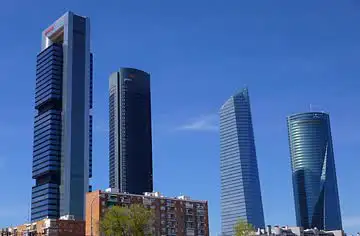
Cuatro Torres Business Area
Spain · Europe
Four skyscrapers in a row on the northern Paseo de la Castellana: Torre de Cristal (249 m, Spain's tallest), Torre Cepsa, Torre PwC and Torre Emperador define Madrid's skyline.
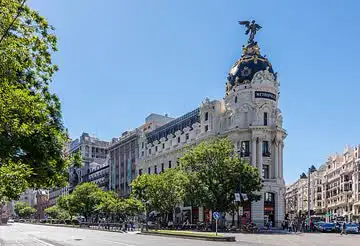
Metrópolis Building
Spain · Europe
A 1911 Beaux-Arts corner building where Calle de Alcalá meets Gran Vía, crowned by a black-slate dome with gilded garlands and a winged Victory statue.
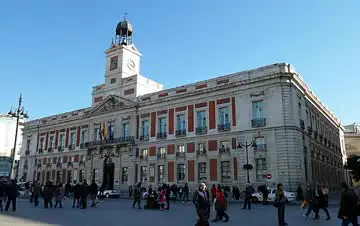
Real Casa de Correos
Spain · Europe
An 18th-century building on the Puerta del Sol; the Kilómetro Cero plaque marking the origin of Spain's radial roads lies in front, and its clock rings in the New Year.
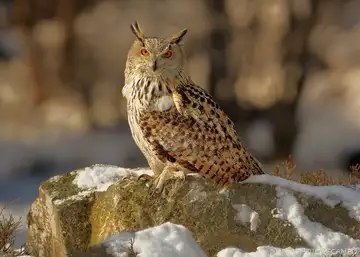
Animals in Spain
Questions
What is the capital of Spain?
The capital of Spain is Madrid.
Which continent is Spain in?
Spain is in Europe.
How big is Spain?
Spain covers about 505,990 km².
How many people live in Spain?
About 47.9 million people live in Spain.
What are the most famous landmarks in Spain?
Some of the best-known landmarks in Spain are Sagrada Família, Alhambra, Mosque–Cathedral of Córdoba, Guggenheim Museum Bilbao and Royal Palace of Madrid. My Earth Toy has 13 landmarks from Spain on its free 3D globe, each with a photo and quick facts.
Which animals can you find in Spain on My Earth Toy?
On the globe you can find Eurasian eagle-owl in Spain.
Sources
Updated: 2026-10-30