
Apollo 11 · Tranquility Base
아폴로 11호 · 고요의 기지
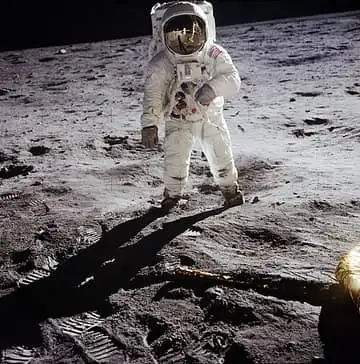
On 20 July 1969 Neil Armstrong and Buzz Aldrin became the first people to walk on the Moon. The lander’s lower stage and a laser mirror are still there; the flag was blown over by the engine at lift-off. With no wind, their footprints will last a very long time.
See it on the 3D Moon →At a glance
- Where
- Sea of Tranquility
- 📅 Landed
- 1969-07-20
- 🚀 Sent by
- NASA (USA)
- 👨🚀 Crew
- Neil Armstrong, Buzz Aldrin (Michael Collins in orbit)
- ⏱️ Time on the Moon
- 21 h 36 min
- Coordinates
- 0.67°N 23.47°E
- Kind
- Landing sites
Apollo 11 was the NASA mission that first landed people on the Moon. On 20 July 1969 the lunar module Eagle touched down on a flat, dark plain called the Sea of Tranquility. The crew named the spot Tranquility Base. Neil Armstrong stepped out first, Buzz Aldrin followed, and Michael Collins circled overhead in the command module Columbia.
The landing answered a challenge President Kennedy set in 1961: to land astronauts on the Moon and bring them safely home. Armstrong and Aldrin stayed on the surface for about 21 and a half hours, walked outside for about two and a half hours, and brought back about 21.5 kg of Moon rock and soil. All three astronauts splashed down in the Pacific Ocean on 24 July 1969.
The mission
A Saturn V rocket launched the crew from Florida on 16 July 1969. Four days later Armstrong and Aldrin flew Eagle down to the surface while Collins waited in orbit. Armstrong radioed that the Eagle had landed, and hours later he climbed down the ladder and spoke his famous words about one small step for a man and a giant leap for mankind. The two astronauts collected samples, took photographs and set up experiments before lifting off to rejoin Collins.
What was left behind
The bottom half of Eagle, called the descent stage, still stands at Tranquility Base, with a plaque on its ladder that ends with the words: we came in peace for all mankind. The crew also left a seismometer to listen for moonquakes and a laser reflector, a panel of special mirrors. Scientists on Earth still bounce laser beams off it to measure the distance to the Moon very precisely. The American flag was blown over by the engine blast when Eagle lifted off.
Why the footprints last
The Moon has almost no air, so there is no wind or rain to wear footprints away. That is why the boot prints at Tranquility Base can stay for a very long time. On Earth, a footprint in beach sand can vanish with the next wave or gust of wind. On the Moon, the fine gray dust simply keeps its shape, so the tracks the astronauts made while setting up experiments and collecting rocks are still lying where they left them.
Fun facts
- Michael Collins went all the way to the Moon but never stepped on it, because he flew the command module in orbit.
- The lunar module was named Eagle after the eagle on the mission badge.
- The laser mirror left by Apollo 11 is still used by scientists today.
- Aldrin saw the flag fall over as Eagle blasted off from the Moon.
On the 3D Moon
On the 3D Moon you can see Tranquility Base with the lander's lower stage and the laser mirror, and the flag lying where the engine blast knocked it over.
More on the Moon

Sources
Updated: 2026-10-19