
Apollo 17 · Taurus–Littrow
아폴로 17호 · 타우루스-리트로
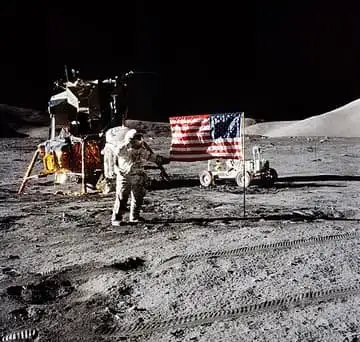
In 1972 people walked on the Moon for the last time so far. They studied a huge split boulder, and Gene Cernan wrote his daughter’s initials in the dust before leaving.
See it on the 3D Moon →At a glance
- Where
- Valley east of the Sea of Serenity
- 📅 Landed
- 1972-12-11
- 🚀 Sent by
- NASA (USA)
- 👨🚀 Crew
- Gene Cernan, Harrison Schmitt
- ⏱️ Time on the Moon
- about 75 h
- Coordinates
- 20.19°N 30.77°E
- Kind
- Landing sites
Apollo 17 was the last Apollo mission to the Moon, and the last time so far that people walked there. In December 1972 Gene Cernan and Harrison Schmitt landed in Taurus–Littrow, a deep valley east of the Sea of Serenity, while Ronald Evans orbited above. Schmitt was a geologist, a scientist who studies rocks, and the only one who has ever walked on the Moon.
The crew stayed about 75 hours, longer than any other Apollo landing. They made three moonwalks totalling about 22 hours, drove their rover about 35.7 km, and collected about 115 kg of samples, the largest haul of any Moon mission. On the way out, the crew took the famous Blue Marble photograph, showing the whole Earth lit up by the Sun.
The mission
Apollo 17 launched just after midnight on 7 December 1972, the first crewed night launch from Kennedy Space Center, and landed on 11 December. The valley was chosen because its rocks were expected to be both older and younger than those from earlier landing sites. Cernan and Schmitt drove to the foot of the surrounding mountains, sampled rocks, and set up science experiments. They left the Moon on 14 December and splashed down in the Pacific on 19 December.
The split boulder and the orange soil
At one stop the astronauts studied a huge boulder, about the size of a house, that had cracked into pieces after rolling down a hillside. It became known as Tracy's Rock, after Cernan's daughter. At a small crater called Shorty, Schmitt spotted soil that was surprisingly orange. Scientists later found it was made of tiny glass beads from volcanic eruptions about 3.5 billion years ago.
The last footprints
Before climbing back into the lander, Cernan traced the letters TDC in the dust, the initials of his nine-year-old daughter, Teresa Dawn. He later said he liked to imagine someone in the future finding the rover, the footprints and the initials and wondering who had been there. His last words on the surface wished the crew of Apollo 17 godspeed. Since then, nobody has stood on the Moon.
Fun facts
- Harrison Schmitt is the only professional geologist who has walked on the Moon.
- Apollo 17 brought back the most Moon samples of any mission, about 115 kg.
- The orange soil Schmitt found is made of tiny volcanic glass beads.
- The Blue Marble photo of the whole Earth was taken by the Apollo 17 crew.
On the 3D Moon
On the 3D Moon you can see the Taurus–Littrow valley, the last place people walked, with the big split boulder the crew studied and Cernan's initials for his daughter in the dust.
More on the Moon




Sources
- Read more on Wikipedia
- Apollo 17 — Wikipedia
- Apollo 17 — NASA
- Gene Cernan, Last Astronaut on the Moon, Dies at 82 — NBC New York (AP)
Updated: 2026-10-19