
Chang’e 4 · Yutu-2
창어 4호 · 위투 2호
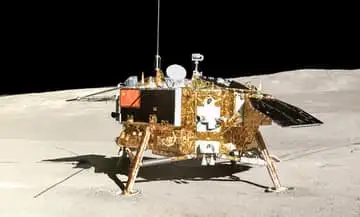
In 2019 this became the first spacecraft to land on the far side. Earth can’t be seen from there, so it talks to us through the relay satellite Queqiao. Its little rover Yutu-2 kept on driving for years.
See it on the 3D Moon →At a glance
- Where
- Far side · Von Kármán crater
- 📅 Landed
- 2019-01-03
- 🚀 Sent by
- CNSA (China)
- 🛞 Rover
- Yutu-2
- Coordinates
- 45.44°S 177.60°E
- Kind
- Landing sites
Chang'e 4 is a Chinese lander that made the first ever soft landing on the far side of the Moon, the half that always faces away from Earth. It touched down on 3 January 2019 inside Von Kármán crater, which sits in the South Pole–Aitken basin, one of the biggest and oldest impact basins in the Solar System. About 12 hours later it released a small rover, Yutu-2.
The mission is named after Chang'e, the Moon goddess of Chinese folk tales. Yutu means Jade Rabbit, her pet in the legend. Because Earth can never be seen from the far side, the lander and rover talk to Earth through a relay satellite called Queqiao, or Magpie Bridge, parked in space beyond the Moon. Yutu-2 went on to become the longest-working rover on the Moon.
The mission
Queqiao launched first, in May 2018, and settled into a looping orbit near a balance point beyond the Moon called L2, about 65,000 km from the Moon. From there it can see both Earth and the far side. Chang'e 4 itself launched on 7 December 2018 from Xichang in China, entered lunar orbit on 12 December, and landed on 3 January 2019. The landing site was later named Statio Tianhe.
What scientists found
One big goal was to look for material from the Moon's mantle, the layer under the crust. The giant impact that made the South Pole–Aitken basin may have dug deep enough to bring mantle rock up to the surface. In 2019 the team reported that Yutu-2's instruments had found signs of such material. The far side is also very quiet for radio, because the Moon blocks noise from Earth, which makes it a good place to listen to faint radio waves from space.
Seeds on the Moon
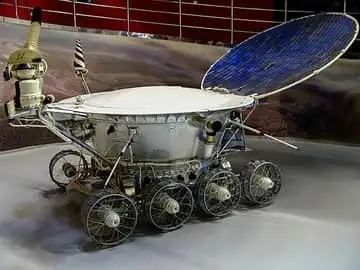
The lander carried a small sealed container, like a tiny garden, with cotton, rapeseed and potato seeds, yeast and fruit fly eggs. The cotton seeds sprouted, the first seeds known to sprout on the Moon. The experiment ended after nine days because the freezing lunar night set in. Meanwhile Yutu-2, designed to last about three months, beat Lunokhod 1's record for the longest-working lunar rover in late 2019.
Fun facts
- Chang'e 4 was the first spacecraft to land gently on the Moon's far side.
- The name of its relay satellite, Queqiao, means Magpie Bridge.
- Cotton seeds sprouted inside the lander, the first seeds known to sprout on the Moon.
- Yutu-2 was built for about three months but kept working for years.
On the 3D Moon
On the 3D Moon you can see Chang'e 4 and its little rover Yutu-2 on the far side, in Von Kármán crater, where Earth never shows in the sky.
More on the Moon

Sources
- Read more on Wikipedia
- Chang'e 4 — Wikipedia
- 창어 4호 — 위키백과
- Chang'e-4, China's mission to the Moon's farside — The Planetary Society
Updated: 2026-10-19