
Apollo 15 · Hadley Rille
아폴로 15호 · 해들리 열구
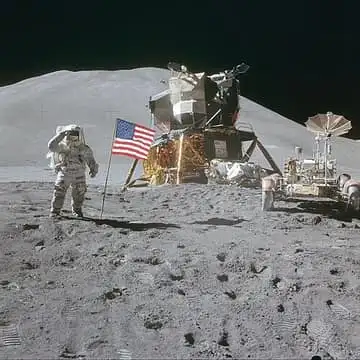
In 1971 astronauts drove a rover on the Moon for the first time. David Scott dropped a hammer and a feather together: with no air, they landed at the same moment.
See it on the 3D Moon →At a glance
- Where
- Edge of the Sea of Rains
- 📅 Landed
- 1971-07-30
- 🚀 Sent by
- NASA (USA)
- 👨🚀 Crew
- David Scott, James Irwin
- 🚙 Distance driven
- 27.8 km
- Coordinates
- 26.13°N 3.63°E
- Kind
- Landing sites
Apollo 15 was the fourth NASA mission to land people on the Moon. In July 1971 David Scott and James Irwin landed at Hadley–Apennine, a spot at the eastern edge of the Sea of Rains. Tall mountains rose on one side and a long, winding canyon called Hadley Rille lay on the other. Alfred Worden orbited above in the command module.
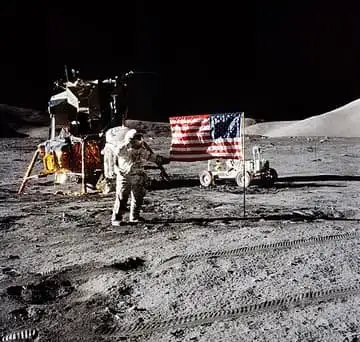
It was the first of the J missions, longer trips built around science. It was also the first time astronauts brought a car to the Moon: the Lunar Roving Vehicle, a light, battery-powered rover. With it, Scott and Irwin could travel much farther from their lander than earlier crews. They drove about 28 km in total and brought home about 77 kg of rocks and soil.
The mission
Apollo 15 launched on 26 July 1971 and landed on 30 July. Scott and Irwin made three long drives across the plain and up the slopes of the mountains, plus a short stand-up look out of the lander's top hatch. Altogether they spent about 18 and a half hours outside. On the way home, Worden made the first spacewalk in deep space, far from Earth, to fetch film from the side of the spacecraft. The crew splashed down in the Pacific on 7 August 1971.
The hammer and the feather
Near the end of the last moonwalk, Scott held up a geology hammer and a falcon feather and let go of both at the same time. On Earth the feather would flutter down slowly because air pushes against it. On the airless Moon, the hammer and the feather fell side by side and hit the ground together. This showed an idea Galileo had described centuries earlier: without air in the way, heavy and light things fall at the same rate.
What scientists found
The crew collected a pale rock that became known as the Genesis Rock. It is a kind of rock called anorthosite and is thought to be a piece of the Moon's very early crust. Before leaving lunar orbit, the crew also released a tiny satellite that measured particles and magnetic fields around the Moon until early 1973. Scott also left a small aluminium figure, the Fallen Astronaut, with a plaque honouring astronauts and cosmonauts who had died.
Fun facts
- Apollo 15 was the first mission to drive a car on the Moon.
- The feather Scott dropped came from a falcon, and the lunar module was named Falcon too.
- The Genesis Rock may be a piece of the Moon's original crust.
- On the way home, Alfred Worden made the first spacewalk in deep space.
On the 3D Moon
On the 3D Moon you can see the Apollo 15 site at the edge of the Sea of Rains, where the first Moon rover drove and where a hammer and a feather were dropped together.
More on the Moon

Sources
Updated: 2026-10-19