
Lunokhod 1
루노호트 1호
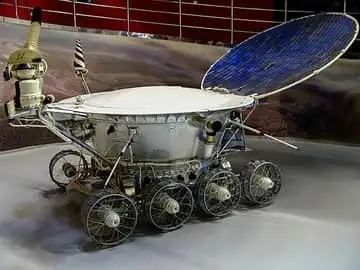
The first remote-controlled rover, sent by the Soviet Union in 1970. Drivers on Earth steered it from TV pictures, and it rolled over 10 km in ten months.
See it on the 3D Moon →At a glance
- Where
- Sea of Rains
- 📅 Landed
- 1970-11-17
- 🚀 Sent by
- Soviet Union
- 🛞 Distance driven
- 10.5 km
- Coordinates
- 38.32°N 35.00°W
- Kind
- Landing sites
Lunokhod 1 was the first robot rover to drive on the Moon, and the first to roam freely across any world other than Earth. The Soviet Union sent it on the Luna 17 spacecraft, which landed in the Sea of Rains on 17 November 1970. The rover rolled down ramps from the lander and set off across the gray plain.
Nobody rode inside it. Instead, a team on Earth steered it by watching television pictures that the rover sent back. Lunokhod 1 was designed to work for about three months but kept going for about ten, travelling about 10.5 km. It sent home more than 20,000 pictures and over 200 wide panoramas, and tested the lunar soil in 25 places.
How it worked
Lunokhod 1 looked like a big tub on eight wheels, each with its own motor. It was about 1.7 m long and weighed about 840 kg. Its lid opened during the long lunar day to show solar panels that charged its batteries. During the freezing two-week lunar night, the lid closed and a small heater warmed by radioactive polonium kept the electronics from freezing. Cameras, soil testers and X-ray instruments helped it study the ground.
Driving from Earth
The rover's own computers were too simple to drive by themselves, so a ground crew did it: a commander, a driver, a navigator, an engineer and an antenna operator. Radio signals take time to travel to the Moon and back, so after each command the drivers had to wait several seconds before they could see the rover move. That made steering around rocks and craters slow, careful work.
Lost and found
Contact ended in September 1971, and for decades nobody knew exactly where the rover had parked. In 2010, NASA's Lunar Reconnaissance Orbiter photographed the landing site and spotted the rover and its wheel tracks. Scientists then fired a laser at the French-built mirror on the rover and got back a surprisingly strong signal. Today it is used, like the Apollo mirrors, to measure the Moon's distance.
Fun facts
- Lunokhod 1 was driven by a five-person team sitting on Earth.
- It lasted about three times longer than planned.
- After going missing for almost 40 years, it was found again in orbiter photos in 2010.
- Its laser mirror still bounces light back to telescopes on Earth.
On the 3D Moon
On the 3D Moon you can see Lunokhod 1 in the Sea of Rains, the first remote-controlled rover, which drivers on Earth steered for more than 10 km.
More on the Moon

Sources
- Read more on Wikipedia
- Lunokhod 1 — Wikipedia
- Lunokhod 1 Revisited — LROC (Lunar Reconnaissance Orbiter Camera)
- Moon and Planets (Lunokhod 1) — StarDate
Updated: 2026-10-19