
Jules Verne’s projectile
쥘 베른의 포탄 우주선
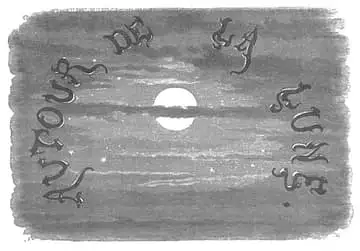
In the 1865 novel, three men ride an aluminium shell fired from the Columbiad, a giant cannon dug into the ground in Florida. In the sequel they never land: they loop round the Moon and splash down in the ocean — strikingly like Apollo, a century later.
See it on the 3D Moon →At a glance
- Where
- Novels: From the Earth to the Moon · Around the Moon
- 📖 Novel
- Jules Verne, 1865 · 1869
- 💥 Cannon
- The Columbiad cannon: about 270 m long
- Kind
- Spacecraft in orbit
More than a hundred years before Apollo, the French writer Jules Verne imagined people flying to the Moon. In his 1865 novel From the Earth to the Moon, members of the Baltimore Gun Club, a group of cannon fans in the United States after the Civil War, decide to fire a giant shell at the Moon. Three men end up riding inside it: the club’s president Impey Barbicane, his rival Captain Nicholl and a French adventurer named Michel Ardan.
The shell is fired from the Columbiad, an enormous cannon dug straight down into the ground at a place called Stone’s Hill near Tampa, Florida. The first book ends with the launch and leaves the travellers’ fate uncertain. The sequel, Around the Moon, published in 1869, follows them through space. Many details turned out to look surprisingly like real Moon missions a century later.
The story
In Around the Moon, the travellers do not land as planned. Their shell ends up circling the Moon instead. They try firing small rockets on the shell’s base to push it down toward the surface, but they fire them too late, and the shell starts falling back toward Earth. It plunges into the sea, where the crew of a US Navy ship, the Susquehanna, find the hollow aluminium capsule floating with all three men alive inside.
Story vs real science
Verne did careful calculations for his time, but a space cannon would not work for people. To reach the speed needed to escape Earth’s gravity, the shell would have to speed up so violently that the passengers would be crushed; a much longer barrel would be needed to make the push gentler. Real spacecraft use rockets instead. Still, Verne got some ideas strikingly right, which is why people still talk about these books.
Surprising echoes of Apollo
Like Apollo 11, Verne’s mission carried three people and launched from Florida. His cannon was called the Columbiad, and Apollo 11’s command module was named Columbia. His capsule was mostly aluminium, splashed down in the sea and was picked up by the Navy, as Apollo crews were. On the way home from the Moon in 1969, Neil Armstrong even mentioned that a hundred years earlier, Jules Verne had written a book about a voyage to the Moon.
Fun facts
- Verne’s giant cannon, the Columbiad, was dug about 900 feet (about 270 m) deep into the ground in Florida.
- Apollo 11’s command module was called Columbia, very close to the name of Verne’s cannon.
- In the sequel, the travellers circle the Moon without landing and splash down in the sea, much like later Apollo missions.
- Neil Armstrong mentioned Jules Verne during Apollo 11’s trip home from the Moon.
On the 3D Moon
On the 3D Moon, Jules Verne’s projectile circles the Moon on a long, stretched orbit, just as it does in the novel Around the Moon. Open its card to read about the 1865 story and its giant cannon.
More on the Moon

Sources
- Read more on Wikipedia
- From the Earth to the Moon — Wikipedia
- Around the Moon — Wikipedia
- From the Earth to the Moon; and, Round the Moon by Jules Verne — Project Gutenberg
- Over the Moon — Futility Closet
Updated: 2026-10-19