
Blue sea star
파란불가사리
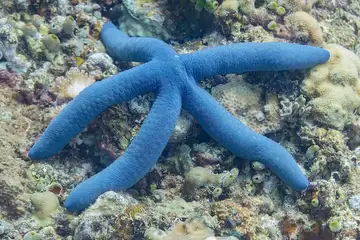
The blue sea star is a vivid blue starfish with five smooth, thick arms that lives on coral reefs of the Indian and western Pacific oceans. A single detached arm can regrow into a whole new animal. It is about 30 cm across.
See it on the 3D globe →At a glance
- Class
- Sea stars & urchins
- Lives in
- Mozambique Channel, off western Madagascar
- Habitat
- coral reefs
Quick answers
Where does the Blue sea star live?
It lives in coral reefs of the Indian and Pacific oceans. On the globe you can find it near Mozambique Channel, off western Madagascar.
The blue sea star, or blue Linckia, is a vivid starfish of shallow tropical waters in the Indo-Pacific. It lives on coral reefs and in seagrass beds, resting on sand or hard ground. It can reach about 30 centimetres across, and its five thick arms have rounded tips.
The most common colour is blue, from dark to light, but some are aqua, purple or orange. It moves slowly, at about 8 centimetres per minute. It lives at low density on reefs and sand, where it crawls only about 8 centimetres a minute. Its tube feet are short and yellowish, and its skin is firm to the touch.
A star that can regrow
Sea stars of this genus can regrow lost arms, and can even drop an arm on purpose to escape a predator. A related species, Linckia multifora, grows a whole new star from a detached arm, called a comet. Scientists see many blue Linckia missing arms or in the comet form, so they think it does the same. Its scientific name laevigata means smooth, a good match for its sleek, glossy arms.
Who eats it?
Blue sea stars are not common anywhere, so each one is thinly spread across a reef. Pufferfish, triton snails, harlequin shrimp and even some sea anemones have been seen eating all or part of them. Parts of the same star may even grow into new animals. Another sea star in the family, Linckia multifora, is known to do this in aquariums.
Fun facts
- A single arm broken off this sea star can regrow into a whole new animal.
- The blue sea star can grow up to 30 centimetres wide.
- It crawls at only about 8 centimetres per minute.
- Some individuals are aqua, purple or orange instead of blue.
On the globe
The model shows a bright blue five-armed starfish. Look for it on tropical coral reefs.
More like this
,_Anilao,_Filipinas,_2023-08-25,_DD_63.jpg)
Sources
Updated: 2026-10-14