
Purple sea urchin
보라성게
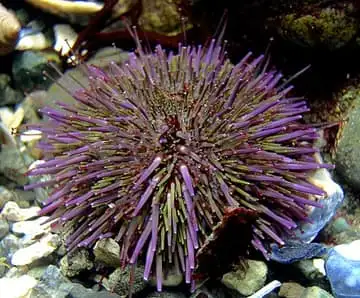
A spiny ball of a sea creature that creeps slowly on hundreds of tiny tube feet between its spines. Inside its mouth is a five-toothed scraper called Aristotle's lantern, used to graze algae off rocks.
See it on the 3D globe →At a glance
- Class
- Sea stars & urchins
- Diet
- Plant eater (herbivore)
- Habitat
- coasts
Quick answers
Where does the Purple sea urchin live?
It lives in coasts of the Pacific Ocean.
What does the Purple sea urchin eat?
Its diet: plant eater (herbivore).
The purple sea urchin (Strongylocentrotus purpuratus) is a round, spiny sea animal that lives along the eastern edge of the Pacific Ocean, from Ensenada in Mexico to British Columbia in Canada. It is deep purple, normally grows to about 10 centimetres across, and lives in the lower part of the tidal zone and in shallow water close to shore. Its hard shell is called a test.
Sea urchins belong to the echinoderms, the group that includes starfish and sea cucumbers. Purple sea urchins may live as long as 70 years. Scientists use them as a model organism in research, and in 2006 the purple sea urchin became the first echinoderm to have its genome sequenced.
A star of science
Teams from more than 70 institutions completed and annotated the genome in 2006. It has about 23,500 genes. By the strictest measure, the purple sea urchin and humans share 7,700 genes. Sea urchins are the closest living relatives of the chordates, the group that includes animals with backbones, so researchers use them to study how bodies develop and how immune systems work.
Many of its genes help it sense the environment, which is surprising for an animal without a head. It also has a chemical defence system that reacts when it senses stress, to clear away toxic chemicals.
Life in the kelp forest
The purple sea urchin is a prominent member of the kelp forest community, along with sea otters and abalones. It breeds in the water, with females releasing orange eggs and males white sperm, mostly in January to March, and urchins are mature by about two years old.
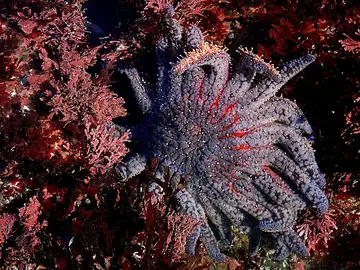
When urchins eat all the kelp in an area they leave an urchin barren. Since 2013, off California and Oregon, a crisis has followed: sunflower sea stars, which hunt urchins, nearly vanished from sea star wasting disease, sea otters declined too, and the urchins boomed and consumed large stretches of bull kelp.
People and urchins
Indigenous peoples of California ate the yellow egg mass, or roe, of sea urchins raw. In California the peak season for eating them is September to October, when the gonads are fully grown. Harvest stress can cause them to spawn, which lowers quality.
Since 2018, volunteer divers smashed purple urchins with hammers to protect kelp, but local laws stopped this because the species is native and not considered invasive. A local company tried farming urchins to grow bigger gonads, hoping to create demand.
Fun facts
- Its five-toothed mouth is called 'Aristotle's lantern'.
- Its chewing organ is called Aristotle's lantern.
- It can live up to 70 years.
- It was the first echinoderm with a sequenced genome.
- Its tube feet let it walk in any direction.
On the globe
The toy model shows a purple sea urchin on the rocky seabed of the Pacific coast.
More like this

Sources
Updated: 2026-10-14