
Sea cucumber
해삼
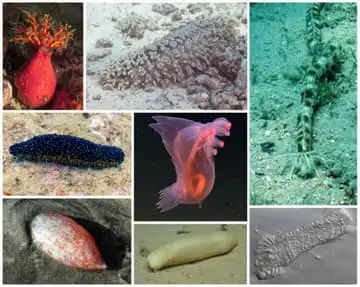
Shaped like a fat cucumber, it is a cousin of starfish and sea urchins that eats sand and debris on the seafloor and leaves it cleaner. Some species can eject part of their insides to escape danger, then regrow them.
See it on the 3D globe →At a glance
- Class
- Sea stars & urchins
- Habitat
- coasts, coral reefs, deep sea
Quick answers
Where does the Sea cucumber live?
It lives in coasts, coral reefs, deep sea of the Pacific, Atlantic, Indian, Arctic and Southern oceans.
Sea cucumbers are echinoderms of the class Holothuroidea, the same big group as starfish and sea urchins. They live on the sea floor all over the world, and about 1,786 species are known, with the most in the Asia-Pacific region. They have leathery skin and an elongated body, named for their resemblance to the cucumber fruit.
Most are 10 to 30 centimetres long, but a few are only millimetres, and Synapta maculata can pass 3 metres. A mouth ringed with tentacles sits at one end and the anus at the other. In many countries people eat them, and the dried product is called trepang, namako or bêche-de-mer, a delicacy in Asian cooking. In the ocean they help recycle nutrients as detritivores.
Odd bodies
Sea cucumbers do not look like other echinoderms at first glance. They have a tubular body with no visible skeleton, though inside the skin are tiny hard pieces joined by tissue. Their body wall has catch collagen that can loosen or tighten at will. Most have five rows of tube feet, shapes range from almost round sea apples to snake-like forms.
Most species rest on one side, called the trivium, with three rows of tube feet, while the upper side is the bivium. Some deep-sea species have almost no skeleton at all.
Defence tricks
Sea cucumbers contain toxins, in particular holothurin, which keep most predators away. Some coral-reef species can expel sticky threads called cuvierian tubules to tangle an attacker, and when startled they may push some out through a tear in the body wall, a process called evisceration.
If the water gets too warm, some species from temperate seas can aestivate, a kind of summer sleep. A few specialist predators, such as large tun shell snails, can still paralyse and swallow them.
Living in the deep
Sea cucumbers are common on the deep sea floor, where they often make up most of the animal weight. Below 8,900 metres they are 90 percent of the weight of larger animals. A species called Myriotrochus bruuni has been found as deep as 10,687 metres.
Some deep-sea groups are nearly as dense as water and can leap up to 1,000 metres, then drift slowly back down. Most feed on plankton and decaying matter, picking over the bottom with their tentacles. In the South Pacific, dense groups at 40 animals per square metre process large amounts of sediment.
Fun facts
- Some sea cucumbers defend themselves by squirting out their internal organs, which later grow back.
- Sea cucumbers breathe through their back end.
- Some shoot out sticky threads to trap predators.
- They are cousins of starfish and sea urchins.
- Strawberry sea cucumbers in a New Zealand fiord reach 1,000 animals per square metre.
On the globe
The toy model shows a sea cucumber on the sea floor, one of the quiet cleaners of the ocean.
More like this

Sources
Updated: 2026-10-14