
Sunflower sea star
해바라기불가사리
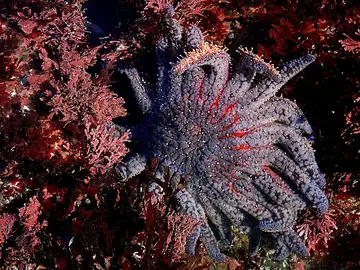
One of the largest sea stars, up to about 1 m across with 16–24 arms, and among the fastest. Sea star wasting disease since 2013 has wiped out most of them, making it critically endangered.
See it on the 3D globe →At a glance
- Class
- Sea stars & urchins
- Lives in
- North Pacific coast, Alaska to Baja California
- Diet
- Meat eater (carnivore)
- Conservation status
- Critically Endangered (IUCN CR)
- Habitat
- coasts
Quick answers
Where does the Sunflower sea star live?
It lives in coasts of the Pacific Ocean. On the globe you can find it near North Pacific coast, Alaska to Baja California.
What does the Sunflower sea star eat?
Its diet: meat eater (carnivore).
Is the Sunflower sea star endangered?
It is listed as Critically Endangered (IUCN CR).
The sunflower sea star is one of the largest sea stars in the world. Its arm span can reach about one metre, and it usually has 16 to 24 arms that give it a sunflower-like look. It weighs about 5 kilograms, making it the heaviest known sea star. It is soft and velvety, and its colour can be orange, yellow-red, brown or even purple.
It lives in the cold waters of the northeast Pacific, from Alaska down to southern California. For a sea star it moves quickly, about one metre per minute, using thousands of tiny tube feet. Since 2013 a sea star wasting disease has killed most of them, and in 2020 it was classified as Critically Endangered.
A fast, hungry hunter
Underneath its body are about 15,000 tube feet, tiny sticky feet that let it crawl and grip. It hunts sea urchins, clams, snails and crabs. By eating sea urchins it helps protect kelp forests, because urchins can chew down kelp. Young sunflower stars grow about 8 centimetres a year, and growth slows when they are older.
The disease
Between 2013 and 2015 sea star wasting disease and warm water caused a rapid collapse. In waters near Washington the population dropped by 99.2 percent, and the species vanished from the coasts of California and Oregon. Scientists later linked the disease to a bacterium, Vibrio pectenicida. Without the sea stars, sea urchins can multiply and eat kelp forests.
Fun facts
- It can have up to 24 arms.
- It can crawl at about a metre a minute using about 15,000 tube feet.
- It is the heaviest known sea star at about 5 kilograms.
- The 2013 wasting disease wiped out most of the population.
On the globe
On the toy globe the sunflower sea star lies on the North Pacific coast, from Alaska to Baja California. Look for its many arms.
More like this

Sources
Updated: 2026-10-14