
Sea star
불가사리
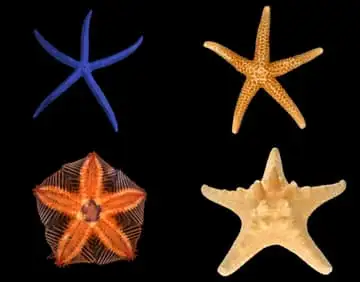
Not a fish at all but a relative of sea urchins, walking and prying open shellfish with hundreds of tiny tube feet under its arms. It has no brain, and it can regrow a lost arm, in some species even a whole new body.
See it on the 3D globe →At a glance
- Class
- Sea stars & urchins
- Diet
- Meat eater (carnivore)
- Lifespan
- up to about 35 years
- Habitat
- coasts, coral reefs, deep sea
Quick answers
Where does the Sea star live?
It lives in coasts, coral reefs, deep sea of the Pacific, Atlantic, Indian, Arctic and Southern oceans.
What does the Sea star eat?
Its diet: meat eater (carnivore).
How long does the Sea star live?
It can live up to about 35 years.
Starfish, also called sea stars, are not fish. They are echinoderms of the class Asteroidea, relatives of sea urchins and sea cucumbers, and they are generally shaped like a star. About 1,900 species live on the seabed in all the world's oceans, from warm tropical zones to frigid polar regions, and from the intertidal zone down to abyssal depths at 6,000 metres.
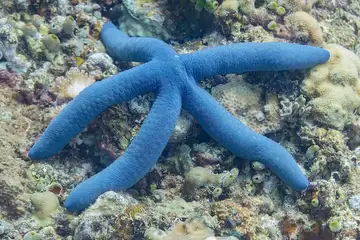
Most have a central disc and five arms, though some species have six, seven or 10 to 15, and the Antarctic Labidiaster annulatus can have more than fifty. Many are brightly coloured in red or orange, while others are blue, grey or brown. The fossil record goes back about 450 million years to the Ordovician period, but it is sparse because starfish fall apart after death and leave only small bony plates and spines.
Water-powered feet
Starfish have tube feet worked by a hydraulic system, and the mouth sits at the centre of the lower surface. Their skin hides a skeleton of calcium carbonate pieces called ossicles. They have two vascular systems, one for water that supports movement and another for blood.
Starfish are opportunistic feeders and mostly hunt animals that live on the bottom. Some species push their stomach out of the body to digest prey, and several have special feeding styles, including suspension feeding.
Big roles in the sea
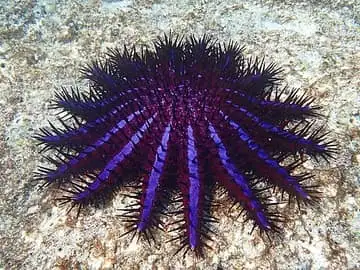
Some starfish have an outsize effect on their home. The ochre sea star and the reef sea star are keystone species, and the tropical crown-of-thorns starfish is a voracious coral eater across the Indo-Pacific. The Northern Pacific seastar appears on a list of the worst invasive alien species.
Most starfish can regenerate damaged parts or lost arms, and they can shed an arm on purpose as a defence.
Many ways to have babies
Most starfish species have separate males and females. Some are hermaphrodites, and some change sex as they grow, such as Asterina gibbosa, which starts as a male. In Nepanthia belcheri, a large female can split in half, and the offspring start out as males, then change back into females.
In most species the eggs and sperm are released into the water and the larvae drift in the plankton. In others the mother broods her eggs, often by sitting humped over them, and the young develop directly into small starfish.
Fun facts
- Sea stars can regrow arms they have lost.
- A starfish is not a fish.
- One Antarctic species can have more than fifty arms.
- The oldest starfish fossils are about 450 million years old.
- Starfish live from shallow pools to about 6,000 metres deep.
On the globe
The toy model shows a starfish resting on the sea floor.
More like this

Sources
Updated: 2026-10-14