
Crown-of-thorns starfish
악마불가사리
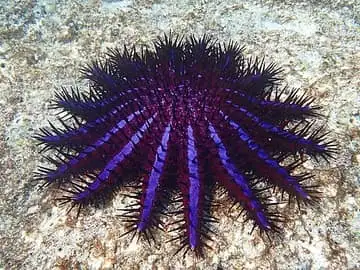
The crown-of-thorns starfish is covered in venomous spines and eats living coral. It has 10 to 20 arms and can reach about 40 cm across. When its numbers boom, it can strip large areas of reef.
See it on the 3D globe →At a glance
- Class
- Sea stars & urchins
- Diet
- Meat eater (carnivore)
- Habitat
- coral reefs
Quick answers
Where does the Crown-of-thorns starfish live?
It lives in coral reefs of the Pacific and Indian oceans.
What does the Crown-of-thorns starfish eat?
Its diet: meat eater (carnivore).
The crown-of-thorns starfish is a large starfish that feeds on hard coral. It gets its name from the venomous, thorn-like spines that cover its upper side, like the biblical crown of thorns. It lives on coral reefs of the Indo-Pacific, from the Red Sea and East Africa to the Pacific coast of Central America, and is common around Australia.
Adults are usually 25 to 35 centimetres across and can have up to 21 arms. They come in purple, blue-purple, reddish-grey, brown or green with yellow tips. When their numbers boom, they can eat huge areas of living reef, and outbreaks are a main cause of coral loss on the Great Barrier Reef.
A star with a hungry stomach
Unlike most starfish with five arms, this one has many, and it begins life with five-fold symmetry before losing it. Each arm has two rows of tube feet and it can bend and twist around the coral it eats. It has a very large stomach for its size. The starfish even has true image-forming vision. Its spines are 4 to 5 centimetres long, sharp, and they can pierce soft surfaces.
Why can outbreaks be a problem?
A starfish's body form is basically the same as other starfish, with a central disc and arms, but its appetite is not. When the animals gather in large numbers, they kill live coral polyps faster than coral can regrow. Stings from the venomous spines are painful, so nobody should touch one. The starfish is a natural part of the reef, and only the huge booms cause trouble.
Fun facts
- Population outbreaks of this starfish are a major cause of coral loss on the Great Barrier Reef.
- It can have up to 21 arms.
- Its spines are 4 to 5 centimetres long and venomous.
- It has true image-forming vision.
- Outbreaks are a major cause of coral loss on the Great Barrier Reef.
On the globe
The model sits on a coral reef in the Indo-Pacific. Look for the many arms covered with spines.
More like this
.jpg)
Sources
Updated: 2026-10-14