
Pacific sea nettle
태평양바다쐐기해파리
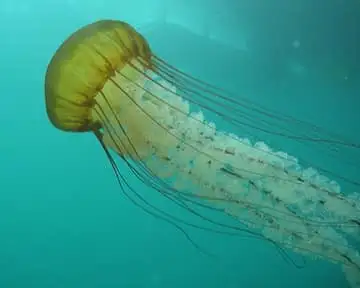
A bell-shaped jellyfish trailing long, thin tentacles whose stinging cells give a sharp sting. The tentacles can stretch several metres. It drifts with the current and snares small animals in the water.
See it on the 3D globe →At a glance
- Class
- Jellyfish & corals
- Diet
- Meat eater (carnivore)
- Habitat
- coasts
Quick answers
Where does the Pacific sea nettle live?
It lives in coasts of the Pacific Ocean.
What does the Pacific sea nettle eat?
Its diet: meat eater (carnivore).
The Pacific sea nettle (Chrysaora fuscescens), also called the West Coast sea nettle, is a widespread jellyfish of the northeastern Pacific. It lives in temperate to cooler waters from British Columbia down the West Coast of the United States to Baja California Sur in Mexico. It has a golden-brown bell with a reddish tint, long frilly whitish oral arms and 24 maroon tentacles that can trail as far as about 4.6 metres.
It is named for its sting, which, like the stinging nettle plant, is often irritating and possibly mildly painful to humans, though rarely dangerous. The bell can be more than a metre across in the wild, but most are under 50 centimetres. Since about the mid-20th century it has been a very popular animal in aquariums, because of its bright colours and long tentacles, and because it is easy to keep.
A drifting hunter
Like all cnidarians, the sea nettle is a carnivore. It catches prey by drift feeding, letting its tentacles hang like a big net. When prey touches them, thousands of stinging cells fire barbed threads that inject venom made of proteins that can disrupt cell membranes.
It eats zooplankton, crustaceans, salps, small fish and their eggs and larvae, and other jellies. It swims by squeezing its bell, which can push it against currents, though it mostly floats. Small fish and crabs sometimes hide inside its bell and may feed on it.
Where and when
The sea nettle is common along southern British Columbia, Washington, Oregon and most of California down to Baja California Sur. Some drift north to the Gulf of Alaska or west to Japan. Numbers peak in late summer. Light-sensing organs called ocelli help them move up from deep water to the surface.
In recent years it has become very abundant off Oregon. Some scientists link this to climate change, while others think farm and industrial runoff feed algal blooms and the whole food chain, giving the nettles more food.
From polyp to jelly
The sea nettle can reproduce both sexually, as a medusa, and asexually, as a polyp. A female catches sperm released by a male and keeps the fertilised eggs on her oral arms, where they become bean-shaped planulae, swimming larvae.
These settle on a hard surface as flower-shaped polyps, which make identical copies of themselves by budding. Each new polyp is released and grows a bell, arms and tentacles until it is a full medusa. Aquarists can breed the species from polyps.
Fun facts
- Its bell can grow to about 1 m across, though most are much smaller.
- Its trailing arms can reach around 4.6 metres.
- The bell sometimes passes one metre but most are smaller than 50 cm.
- The genus name refers to Chrysaor, a figure from Greek myth whose name means he who has a golden armament.
- Aquarists can breed it from polyps.
On the globe
The toy model shows a sea nettle jellyfish trailing its long tentacles in the Pacific.
More like this
_2.jpg)
Sources
Updated: 2026-10-14