
Black caiman
검은카이만
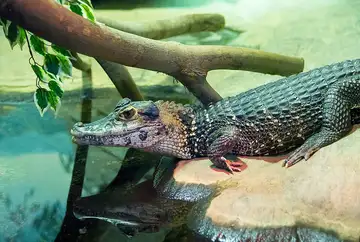
The black caiman is one of the largest predators of the Amazon basin and can exceed 5 metres in length. It has a dark body and a broad snout, and hunts fish and mammals such as capybaras.
See it on the 3D globe →At a glance
- Class
- Reptiles
- Lives in
- Rivers, lakes and swamps of the Amazon basin
- Diet
- Meat eater (carnivore)
- Length
- about 3 m
- Conservation status
- Least Concern (IUCN LC)
- Habitat
- rivers & lakes, wetlands, rainforests
Quick answers
Where does the Black caiman live?
It lives in rivers & lakes, wetlands, rainforests. On the globe you can find it near Rivers, lakes and swamps of the Amazon basin.
How big is the Black caiman?
It grows to about 3 m.
What does the Black caiman eat?
Its diet: meat eater (carnivore).
Is the Black caiman endangered?
It is listed as Least Concern (IUCN LC).
The black caiman is one of the biggest predators of the Amazon. It is the largest living member of the alligator family, reaching 5 to 6.5 metres long and weighing over 450 kilograms. Adults are dark greenish-black, and some look almost jet black.
It lives only in South America, in slow rivers, lakes and seasonally flooded grasslands. As an apex predator, it eats fish, reptiles, birds and mammals and probably helps keep its whole ecosystem in balance. It is the third-largest crocodilian in the Neotropics, the tropical regions of the Americas. It has a head that is large and heavy, ideal for catching bigger prey, and it is one of the world's great crocodilians.
Built for the water
Like other crocodilians, the black caiman has thick scaly skin, a long tail and eyes and nostrils on top of its head, so it can see and breathe while the rest of its body stays under water. Its big, heavy head helps it catch large prey. Its eyes and nose on top of its head let it hide almost completely. Adults can ambush large animals that come to drink, while young ones eat smaller things such as fish and insects.
Nests and young
Mating happens in the dry season. Females build a nest mound with an egg chamber to protect the eggs. After hatching, the babies stay in groups called pods, guarded by the mother. Young caimans have pale yellow bands on their flanks that help hide them. People once hunted the species almost to extinction. Hatchlings form pods guarded by the female, and a pod may include young from other nests, so a mother may end up watching over many babies.
Fun facts
- It is the largest predator in the Amazon, and old males can grow over 5 m long.
- It is the largest living species in the alligator family.
- Babies have pale bands that break up their outline.
- Its hatchlings stay together in pods watched over by the mother.
On the globe
The model shows a big dark caiman with a broad head. Look for it along the rivers of South America.
Quiz time
Which is longer: Black caiman or Green anaconda?
Show the answer
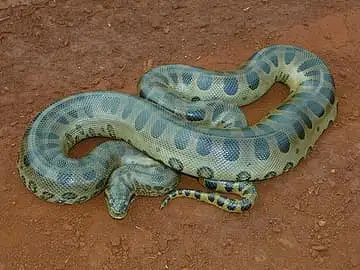
Green anaconda. (3 m vs 4.5 m) Green anaconda →
More like this

Sources
Updated: 2026-10-14