
Hispaniolan solenodon
히스파니올라솔레노돈
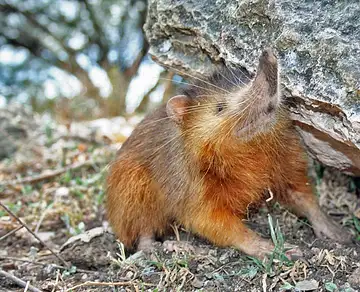
A rare insectivore of Hispaniola that looks like a big shrew, with a long flexible snout, a bald scaly tail and strong claws. It is one of the few venomous mammals, delivering toxic saliva through grooved teeth.
See it on the 3D globe →At a glance
- Class
- Mammals
- Lives in
- Forests of the Dominican Republic
- Diet
- Insect eater
- Conservation status
- Least Concern (IUCN LC)
- Habitat
- forests
Quick answers
Where does the Hispaniolan solenodon live?
It lives in forests. On the globe you can find it near Forests of the Dominican Republic.
What does the Hispaniolan solenodon eat?
Its diet: insect eater.
Is the Hispaniolan solenodon endangered?
It is listed as Least Concern (IUCN LC).
The Hispaniolan solenodon (Solenodon paradoxus), also called the agouta, is a small, furry, shrew-like mammal found only on the Caribbean island of Hispaniola, shared by the Dominican Republic and Haiti. It is a venomous, insect-eating animal that lives in burrows and is active at night. It is elusive, and numbers are stable in protected forests, but it is the focus of conservation efforts.
Adults are 49 to 72 centimetres long including a tail of 20 to 25 centimetres, and weigh about 800 grams on average, which makes them the largest living members of their group. They are dusky brown with paler undersides and reddish fur on the sides of the head, throat and upper chest. The tail, legs, snout and eyelids are hairless. Together with the rat-like Hispaniolan hutia, it is one of the only two surviving mammals native to the island.
Lost and found, twice
In 1833 the Russian Academy of Sciences received a new specimen from Haiti. Puzzled by it, the curator Johann Friedrich von Brandt named it Solenodon paradoxus, and Solenodon means grooved teeth. Little else was known, and the animal was believed extinct.
Addison Emery Verrill and Alpheus Hyatt Verrill rediscovered it in the Dominican Republic in 1907, but by 1964 it was believed extinct again. Its smaller sister species, Marcano's solenodon, died out after European colonisation.
Venom, whiskers and digging claws
The second lower incisor has a narrow, almost closed channel through which venomous saliva flows from a gland. The exact chemicals are unknown, but injecting 0.38 to 0.55 milligrams per gram of body mass was fatal to mice in two to six minutes.
The long snout carries about a dozen whiskers up to 7 centimetres long, and a bone called the os proboscidis, found in no other solenodon, supports the snout. The forelegs are stronger than the hind legs, and all have strong digging claws. It probes soil with its snout and rips open rotten logs with its claws.
Night, burrows and babies
By day solenodons hide in burrows, trees, hollow logs or caves. A burrow with several chambers and tunnels is usually home to an adult pair and up to six younger family members. Out in the open they run on the soles of their feet in an erratic zigzag. They eat mostly millipedes, beetles and other insects, plus worms, snails and small reptiles, and have been recorded making echolocation clicks.
Breeding can happen all year. A litter of one to three young is born after more than 84 days, but usually only two survive, since the mother has only two teats. Without natural land predators, solenodons evolved few defences and are slow and clumsy, so feral dogs and cats and introduced mongooses threaten them.
Fun facts
- It is one of the few venomous mammals, delivering venom through grooves in its lower teeth.
- Its name means grooved tooth.
- It was once thought to be extinct, twice.
- Its snout has a special supporting bone.
- Genetic work shows solenodons split from all other living mammals about 78 million years ago.
On the globe
The toy model shows a solenodon in the forests of the Dominican Republic.
More like this

Sources
Updated: 2026-10-14