
The black slab in Tycho
티코의 검은 석판
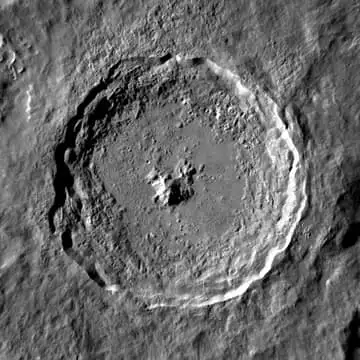
In the film “2001: A Space Odyssey” (1968), explorers dig up a mysterious black slab in Tycho crater. The real Tycho is a young crater with bright rays you can see on a full Moon without a telescope.
See it on the 3D Moon →At a glance
- Where
- Tycho crater · a film homage
- 🎬 Film
- 2001: A Space Odyssey (1968)
- ⭕ Size
- Tycho crater: about 85 km across
- Coordinates
- 43.30°S 11.20°W
- Kind
- Stories
Tycho is one of the most eye-catching craters on the Moon. It sits in the southern highlands, is about 85 km across and about 4.7 km deep, and is named after the Danish astronomer Tycho Brahe. Around a full Moon, bright streaks called rays spread out from it in every direction, some reaching about 1,500 km. You can spot Tycho and its rays without a telescope, and binoculars make them even clearer.
Tycho is also famous in films. In the 1968 science-fiction classic 2001: A Space Odyssey, explorers dig up a mysterious black slab, called a monolith, buried in this crater. The black slab on the 3D Moon is a small homage to that idea. The slab is invented; the crater, its rays and its age are real science.
A young crater
Tycho formed when an asteroid or comet slammed into the Moon about 108 to 110 million years ago. That sounds old, but for the Moon it is young. Older craters get worn down and covered by newer hits, but Tycho still has a sharp rim and steep walls. Its bright rays are made of fresh material thrown out by the impact, which is why they stand out so brightly.
Mountains in the middle
In the centre of Tycho rises a group of mountains, about 15 km wide, which formed when the ground rebounded upward after the impact, a bit like a splash in a pond frozen in rock. In 2011, NASA’s Lunar Reconnaissance Orbiter tilted sideways to photograph these peaks at sunrise, and the dramatic picture won a ‘Moon as Art’ contest. Earlier, in January 1968, the robotic lander Surveyor 7 touched down just north of the crater.
The film idea
2001: A Space Odyssey was directed by Stanley Kubrick, who wrote it together with the science-fiction author Arthur C. Clarke. In the story, the monolith found in Tycho had been buried there about four million years earlier, a sign that someone else had visited long ago. The film is admired for showing spaceflight in a very realistic way for its time, and it won an Oscar for its visual effects. No real monolith has ever been found on the Moon.
Fun facts
- Tycho’s bright rays stretch up to about 1,500 km across the Moon.
- At full Moon, Tycho’s rays are easy to see with binoculars or a small telescope.
- A NASA photo of Tycho’s central peaks at sunrise won a ‘Moon as Art’ contest.
- The film 2001: A Space Odyssey won an Oscar for its visual effects, the only Oscar its director Stanley Kubrick ever won.
On the 3D Moon
On the 3D Moon you can find a black slab in Tycho crater, in the southern part of the near side, as a homage to the film. Open its card to read about the real young crater and its bright rays.
More on the Moon


Sources
- Read more on Wikipedia
- Tycho (lunar crater) — Wikipedia
- Hyperwall: Tycho Central Peak — NASA Scientific Visualization Studio
- 2001: A Space Odyssey — Wikipedia
Updated: 2026-10-19