
Wells’s Cavorite sphere
웰스의 케이버라이트 구체
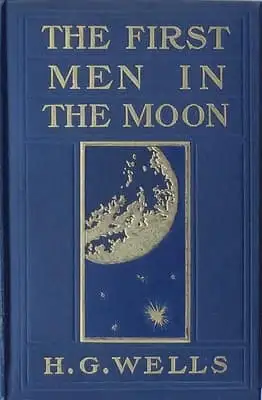
In H. G. Wells’s 1901 novel, the scientist Cavor reaches the Moon in a glass sphere with shutters made of Cavorite, a substance that blocks gravity. Opening and closing the blinds steers it, and inside the Moon live the ant-like Selenites.
See it on the 3D Moon →At a glance
- Where
- Novel: The First Men in the Moon
- 📖 Novel
- H. G. Wells, 1901
- Coordinates
- 8.00°S 0.00°E
- Kind
- Stories
The First Men in the Moon is a science-fiction novel by the English writer H. G. Wells, published as a book in 1901 after appearing in parts in The Strand Magazine and The Cosmopolitan from late 1900. It is told by Mr Bedford, a London businessman, who teams up with an odd, absent-minded scientist called Mr Cavor.
Cavor invents cavorite, an imaginary substance that blocks gravity the way a curtain blocks light. The two men build a sphere covered with cavorite blinds and fly it to the Moon, hoping to find valuable minerals. Instead they find a hidden world under the surface. The book mixes adventure with gentle mockery of human society, and it inspired later Moon stories, including, historians think, Georges Méliès’s 1902 film A Trip to the Moon.
The story
By opening and closing the cavorite blinds, the travellers choose which way gravity pulls them, and they steer across space to the Moon. Below the surface they meet the Selenites, insect-like Moon people who live in a huge, strictly organised underground society, where each one is shaped for a single job. Bedford makes it back to Earth alone. Cavor stays behind and later sends radio messages describing the Moon world, until his final message is suddenly cut off.
Story vs real science
Cavorite is pure invention: no material can switch off gravity, and that is why Jules Verne, who liked to base his stories on real engineering, was unhappy with Wells’s book. Real spacecraft escape Earth by burning rocket fuel, not by blocking gravity. The Moon also has no breathable air and no known life, and the caves that do exist there are empty lava tubes. Wells’s goal was less to predict the future than to look at humanity from far away and poke fun at it.
Why it is still read
The novel was adapted many times: in films in 1919 and 1964, in a BBC Four television film in 2010 by Mark Gatiss, and on BBC radio. The writer C. S. Lewis borrowed its basic setup, a businessman and a scientist building a spaceship, for his own novel Out of the Silent Planet. Today it is free to read online through Project Gutenberg.
Fun facts
- In the novel, the spaceship is steered by opening and closing window blinds made of anti-gravity cavorite.
- Jules Verne disliked the book because cavorite was not real technology.
- The Moon people in the story, the Selenites, live underground and look like insects.
- The book first appeared in parts in The Strand Magazine before it became a book in 1901.
On the 3D Moon
On the 3D Moon you can find Cavor’s glass sphere sitting near the centre of the near side. Open its card to read about H. G. Wells’s 1901 novel.
More on the Moon

Sources
- Read more on Wikipedia
- The First Men in the Moon — Wikipedia
- The First Men in the Moon by H. G. Wells — Project Gutenberg
- A Trip to the Moon — Wikipedia
Updated: 2026-10-19