
The Moon Rabbit and the cassia tree
방아 찧는 달토끼와 계수나무
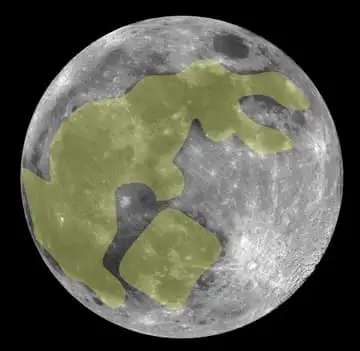
In Korea, China and Japan people see a rabbit pounding a mortar in the Moon’s dark patches. In Chinese legend it makes the elixir of life beside Chang’e, next to a cassia tree that grows back whenever it is cut.
See it on the 3D Moon →At a glance
- Where
- Old tales
- 📜 Story
- Folk tales of China, Korea and Japan
- Coordinates
- 4.00°S 44.00°E
- Kind
- Stories
Look at a full Moon and you will see dark and light patches. Many cultures have found pictures in them. In Korea, China, Japan and Vietnam, people see a rabbit standing over a mortar, pounding something with a long pestle. This is the Moon Rabbit, also called the Jade Rabbit or Moon Hare, one of the best-loved figures in East Asian folklore.
What the rabbit is pounding depends on where you hear the story. In Chinese legend it makes the elixir of life, a medicine that lets you live forever, keeping the Moon goddess Chang’e company. In Japan and Korea it pounds rice to make sweet rice cakes, mochi or tteok. Nearby grows a magical tree that can never be cut down. The legend is still part of autumn Moon festivals across Asia.
The story
The oldest Chinese writings that mention it, in an ancient poetry collection called the Chu Ci, describe a hare on the Moon pounding herbs for the immortals. In the best-known version, Chang’e drank an elixir of immortality, floated up to the Moon and became a fairy there, with a white rabbit as her companion. An old Buddhist tale from India explains how the rabbit got there: a kind hare threw itself into a fire to feed a hungry old man, who turned out to be a god. To honour that kindness, the god drew the hare’s picture on the Moon.
The tree that grows back
Chinese stories also tell of a huge tree on the Moon, often translated as a cassia or sweet osmanthus tree. A man named Wu Gang was sentenced to chop it down, but every time he cut into it, the tree healed itself, so his work never ends. The tale dates back at least to China’s Tang dynasty more than a thousand years ago. In Korea, the rabbit and the cassia tree appear together in the much-loved 1924 children’s song ‘Bandal’ (Half Moon) by Yun Geuk-young.
The legend and real science
The ‘rabbit’ is really made of the Moon’s maria, wide, dark plains of hardened lava, most of which erupted about 3 to 3.5 billion years ago. The bright parts around them are older, rougher highlands. Most maria lie on the side of the Moon that faces Earth, which is why the rabbit is so easy to see. The legend has even reached space: China named its Moon rover Yutu, ‘Jade Rabbit’, after the rabbit of the story.
Fun facts
- China’s Moon rover was named Yutu, which means ‘Jade Rabbit’.
- During Apollo 11, Mission Control joked with the astronauts about a ‘bunny girl’ on the Moon.
- In Japan and Korea the Moon Rabbit makes rice cakes, while in China it makes a medicine for living forever.
- Rabbit stories about the Moon exist in the Americas too, including an Aztec legend.
- In Chinese legend, a man named Wu Gang chops a Moon tree forever because it heals every cut.
On the 3D Moon
On the 3D Moon you can find the Moon Rabbit and the cassia tree on the eastern near side. Open its card to read the old tales from Korea, China and Japan.
More on the Moon



Sources
- Read more on Wikipedia
- Moon rabbit — Wikipedia
- 옥토끼 — 위키백과
- Wu Gang — Wikipedia
- To a Hare Raising Good Year: The Rabbit in Myth and Culture — Roots (National Heritage Board, Singapore)
- 반달 (동요) — 위키백과
- Lunar mare — Wikipedia
Updated: 2026-10-19