
Ina, the puzzling patch
수수께끼의 지형 이나
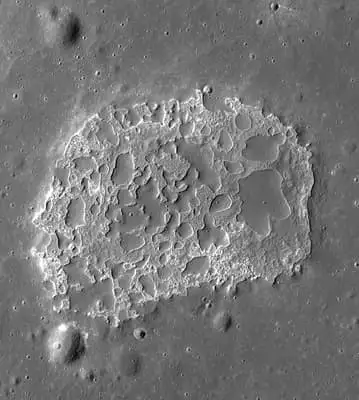
A D-shaped patch of smooth, rounded mounds surrounded by rough, blocky ground. It has hardly any craters, so it looks very young — scientists still argue about whether it is a trace of recent volcanic activity.
See it on the 3D Moon →At a glance
- Where
- Near Lacus Felicitatis
- 📏 Size
- about 2 × 3 km
- ❓ Age
- Tens of millions of years? Billions?
- Coordinates
- 18.65°N 5.30°E
- Kind
- Mysteries
Ina is a small, strange hollow on the Moon’s near side, in a little dark plain called Lacus Felicitatis, the ‘Lake of Happiness’. It is shaped like the letter D, about 2.9 by 1.9 km, and roughly 64 m deep. Its floor is covered with smooth, rounded mounds that look like blobs of frosting, surrounded by lower ground that is rough, blocky and brighter.
What makes Ina puzzling is how few craters it has. On the Moon, more craters usually means an older surface, because meteorites keep hitting it over time. Ina has so few that it looks almost brand new. If it really is young, it would mean the Moon was still having small volcanic eruptions long after scientists thought its volcanoes had gone quiet. Not everyone agrees, and that debate is still going on.
How it was found
The astronauts of Apollo 15 photographed Ina from lunar orbit in 1971. An earlier robotic orbiter had taken a picture of the area, but a flaw in the photo hid the feature. Early reports called it the ‘D-caldera’ because of its shape. A NASA map from 1974 gave it the name Ina, a Latin woman’s name, and the International Astronomical Union made the name official in 1979.
The mystery
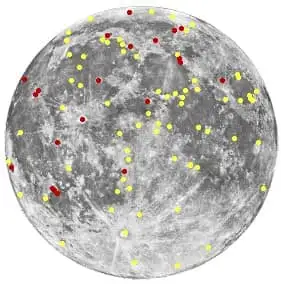
In 2014, a team using NASA’s Lunar Reconnaissance Orbiter found 70 similar ‘irregular mare patches’ across the near side, most of them smaller than 500 m. By counting the few craters on three of them, the team estimated they were less than 100 million years old, and Ina perhaps less than 50 million. That is young for the Moon, whose big lava plains formed billions of years ago. It would mean the Moon’s inside stayed hot enough to make magma for much longer than expected.
What scientists think now
In 2017, another team suggested a different answer. They argued that Ina’s mounds are made of very porous, foamy lava. A foamy surface would make new impact craters smaller and harder to see, so the patch would only look young. By their estimate, Ina could be about 3.5 billion years old, like the lava plain around it. Other ideas include gas escaping from below or soil sinking into hidden holes. A sample brought back from Ina could settle the argument.
Fun facts
- Ina is shaped like a giant letter D on the Moon’s surface.
- Apollo 15 astronauts photographed Ina from orbit in 1971.
- Scientists’ age estimates for Ina range from under 50 million years to about 3.5 billion years.
- Ina is the best known of about 70 similar odd patches found on the Moon’s near side.
On the 3D Moon
On the 3D Moon you can find Ina north of the Moon’s center, in Lacus Felicitatis. Open its card to read why this D-shaped patch has scientists arguing about its age.
More on the Moon





Sources
- Read more on Wikipedia
- Ina (crater) — Wikipedia
- NASA Mission Finds Widespread Evidence of Young Lunar Volcanism — NASA
Updated: 2026-10-19