
Transient lunar phenomena
달의 깜빡이는 빛 (TLP)
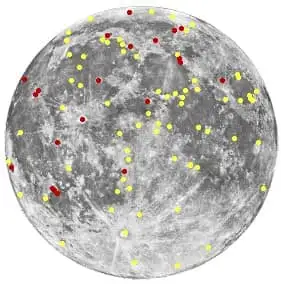
For centuries astronomers have reported brief glows, or reddish and bluish hazes, on the Moon’s surface. Many sightings come from Aristarchus, the brightest crater on the Moon — but nobody is sure what causes them.
See it on the 3D Moon →At a glance
- Where
- Aristarchus crater
- 🔭 Sightings
- Thousands of reports over centuries
- ❓ Cause
- Gas? Dust? Tricks of the eye?
- Coordinates
- 23.70°N 47.40°W
- Kind
- Mysteries
Transient lunar phenomena, or TLPs, are short-lived changes that people have reported seeing on the Moon’s surface: a sudden spark or pulse of light, a reddish or bluish glow, or a patch that turns blurry for a while. ‘Transient’ simply means ‘lasting only a short time’. Reports go back hundreds of years, and one modern catalogue lists more than 2,000 of them.
A large share of the most trusted reports come from one place: Aristarchus, the brightest crater on the Moon, on a high plateau in the Ocean of Storms. Even after the Apollo landings and many orbiting spacecraft, nobody is completely sure what causes these flickers, or how many are real. That makes TLPs one of the Moon’s longest-running small mysteries.
Famous sightings
In 1783 and 1787, the astronomer William Herschel saw red glowing spots on the dark part of the Moon, including near Aristarchus, and thought they were erupting volcanoes. In 1958, the Soviet astronomer Nikolai Kozyrev reported a half-hour ‘eruption’ on the central peak of Alphonsus crater and recorded a spectrum that seemed to show glowing carbon gas. In July 1969, while Apollo 11 was orbiting the Moon, the crew was asked to look at Aristarchus, and Neil Armstrong described an area that looked brighter than its surroundings.
What scientists think
There are several ideas, and different TLPs may have different causes. Gas leaking from cracks under the surface could lift dust or glow; NASA’s Lunar Prospector detected signs of radon gas escaping near Aristarchus. Small meteorites really do make brief flashes of light when they hit, and telescopes now record these regularly. Electric charges could make dust float or spark near the line between day and night. Finally, some reports are probably tricks of Earth’s wobbly air, passing satellites or tired eyes.
Why it is hard to solve
Most TLPs were seen by only one person or from one place, so they are hard to check. When the Clementine spacecraft happened to photograph areas before and after four reported events, scientists could not find any difference. Experts also warn that craters naturally change in brightness and colour as sunlight hits them from different angles during the month. Amateur astronomers still watch Aristarchus and report anything odd, hoping to catch a TLP on camera.
Fun facts
- At least one-third of the most reliable TLP reports come from the Aristarchus area.
- The famous astronomer William Herschel thought he saw volcanoes erupting on the Moon in 1787.
- During Apollo 11, Mission Control asked the astronauts to look at Aristarchus for strange lights.
- Meteorites hitting the Moon make real flashes: one European project recorded 192 of them between 2017 and 2023.
- A NASA catalogue listed 579 strange lunar events seen between 1540 and 1967.
On the 3D Moon
On the 3D Moon you can find this mystery at Aristarchus crater, in the north-west of the near side. Open its card to read about the brief glows astronomers have reported there.
More on the Moon

Sources
- Read more on Wikipedia
- Transient lunar phenomenon — Wikipedia
- Transient Lunar Phenomena (TLP) — Society for Popular Astronomy
- Transient Lunar Phenomena: Regularity and Reality — arXiv
- Lunar transient phenomena report (Cameron, 1971) — NASA Technical Reports Server
Updated: 2026-10-19