
The Marius Hills pit
마리우스 언덕의 구멍
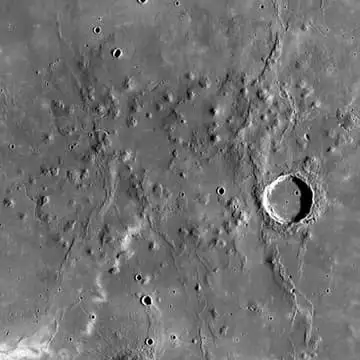
This deep pit, about 60 m across, is a “skylight” where the roof of an underground lava tube fell in. Inside, the temperature stays even and the rock shields against radiation and meteorites — a candidate for a future Moon base.
See it on the 3D Moon →At a glance
- Where
- Ocean of Storms
- 📏 Size
- about 60 m across · 40–90 m deep
- 📅 Found
- 2009 (Japan’s Kaguya)
- Coordinates
- 14.09°N 56.80°W
- Kind
- Mysteries
The Marius Hills are a cluster of low volcanic domes in the Ocean of Storms, a huge dark plain on the Moon’s near side. They are named after Marius, a nearby crater about 41 km wide. In 2009, Japan’s Kaguya (SELENE) orbiter spotted something unusual among them: a deep, nearly round hole with steep walls, sitting inside a winding lava channel.
Scientists think the hole is a ‘skylight’, a spot where the roof of an underground lava tube caved in. A lava tube is a tunnel left behind when the outside of a lava river cools into a crust while hot lava keeps flowing inside and later drains away. That makes this little pit a possible doorway into a hidden cave, and caves like this could one day shelter astronauts.
How big is the pit?
The first report in 2009 described the hole as about 65 m across. Later, NASA’s Lunar Reconnaissance Orbiter (LRO) photographed it at a resolution of half a metre per pixel. Using pictures taken with the Sun higher in the sky, the LRO camera team measured it at about 58 by 49 m and about 40 m deep. Earlier estimates of its depth were deeper, up to around 88 m, so the exact numbers depend on which study you read.
How lava tubes form
Billions of years ago, rivers of runny lava flowed across this region. As the top of a flow cooled and hardened, it formed a roof, while molten rock kept moving underneath like water in a pipe. When the eruption ended, the lava drained out and left an empty tunnel. Kaguya’s radar hinted at empty spaces under nearby channels too, and gravity maps from NASA’s GRAIL mission show places with ‘missing mass’ that could be more tubes.
A future Moon base?
The Moon’s surface is a harsh place. There is no air to block radiation from the Sun and space, tiny meteorites rain down, and temperatures swing wildly between day and night. Deep inside a cave, the rock overhead would block radiation and meteorites, and the temperature would stay much steadier, as it does in caves on Earth. Nobody yet knows whether this pit leads into an open tunnel that people could enter, but it is one of the top places scientists would like to explore.
Fun facts
- This pit was the first lava-tube ‘skylight’ ever found on the Moon, spotted by Japan’s Kaguya orbiter in 2009.
- The pit is about 40 m deep, deep enough to hide a 12-storey building.
- Inside a lava tube, the temperature stays far steadier than on the surface, where day and night are extreme.
- Kaguya’s radar hinted that more hidden tunnels may lie under nearby lava channels.
On the 3D Moon
On the 3D Moon you can find this deep pit in the Marius Hills, in the Ocean of Storms on the Moon’s western near side. Open its card to learn why a hole in a lava cave could become a future Moon base.
More on the Moon



Sources
- Read more on Wikipedia
- Marius Hills — Wikipedia
- Marius Hills Pit - Lava Tube Skylight? — LROC (Arizona State University)
- Lunar skylight discovery (Haruyama et al., 2009) — ScienceDaily
Updated: 2026-10-19