
Ice in Shackleton crater
섀클턴 크레이터의 얼음
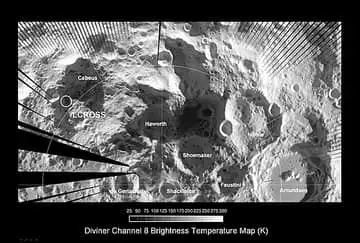
At the Moon’s south pole the Sun always sits low on the horizon, so the floors of deep craters have not seen sunlight for billions of years. Ice hides in that shadow, colder than −170 °C — future water and fuel for astronauts.
See it on the 3D Moon →At a glance
- Where
- South pole
- 📏 Size
- about 21 km across
- 🌡️ Temperature
- floor below about −183 °C
- Coordinates
- 89.67°S 129.80°E
- Kind
- Mysteries
Shackleton is an impact crater sitting right at the Moon’s south pole: the pole itself lies on its rim. It is about 21 km across and about 4.2 km deep, and it is named after the Antarctic explorer Ernest Shackleton. The crater formed more than three billion years ago and has stayed remarkably intact since then.
The Moon’s spin axis is tilted only a tiny amount, so near the poles the Sun always hangs low on the horizon. Sunlight skims across the crater’s rim but never reaches the bottom. The floor has stayed in darkness for billions of years and is one of the coldest places we know of. That endless cold makes it a natural freezer where water ice may survive, which is why space agencies want to land nearby.
Why it never sees the Sun
On Earth, the tilt of our planet gives us seasons, and even the poles get months of daylight. The Moon’s spin axis is tilted only slightly, so the Sun never climbs high at its poles. Inside a deep bowl like Shackleton, the walls block the low sunlight all the time. Parts of the rim, on the other hand, are lit for most of each lunar day cycle, about 80 to 90 percent of the time. That mix of permanent shadow next to almost-constant sunlight is rare and useful.
Is there ice inside?
The crater floor stays below about 100 kelvin, roughly minus 173 °C or colder, cold enough to hold ice for billions of years. In 2012, NASA’s Lunar Reconnaissance Orbiter bounced laser light off the floor and found it was brighter than nearby craters. Scientists said ice might make up as much as 22 percent of the surface material there. Other measurements, such as Japan’s Kaguya camera and Earth-based radar, did not see clear signs of exposed ice, so the amount is still being debated. Only a lander or rover can settle it.
Why astronauts want to go
Water on the Moon would be precious. Astronauts could drink it, and splitting it into hydrogen and oxygen would give them air to breathe and rocket fuel. The sunny rim could power solar panels for most of the time, and the crater region is a leading candidate for landings in NASA’s Artemis program. China’s Chang’e 7 mission also plans to explore the south pole region to search for water ice.
Fun facts
- The Moon’s south pole sits right on the rim of Shackleton crater.
- The crater’s floor has not seen direct sunlight for billions of years.
- The crater formed more than three billion years ago and is still remarkably intact.
- Ice may make up as much as 22 percent of the soil on the crater floor, according to a 2012 NASA study.
- The crater is named after Ernest Shackleton, a famous explorer of Earth’s Antarctica.
On the 3D Moon
On the 3D Moon you can find Shackleton crater at the very bottom of the Moon, at the south pole. Open its card to see why ice may hide in its never-lit shadow.
More on the Moon

Sources
- Read more on Wikipedia
- Shackleton (crater) — Wikipedia
- NASA Lunar Reconnaissance Orbiter Reveals Ice Content in Shackleton Crater on the Moon — Astrobiology (NASA release)
Updated: 2026-10-19