
The Moon rang like a bell
종처럼 울린 달
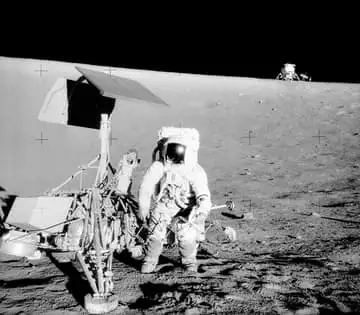
In 1969, after the astronauts left, the empty ascent stage was crashed into the Moon on purpose. The seismometer recorded the Moon ringing like a bell for almost an hour: its dry, broken rock lets vibrations last far longer than on Earth.
See it on the 3D Moon →At a glance
- Where
- Near where Apollo 12’s ascent stage hit
- 📅 Impact
- 1969-11-20
- ⏱️ Ringing
- shook for about 55 minutes
- Coordinates
- 8.50°S 20.50°W
- Kind
- Mysteries
In November 1969, the Apollo 12 astronauts Pete Conrad and Alan Bean landed in the Ocean of Storms and set up a seismometer, an instrument that feels the ground shaking. After they flew back up to their mothership, the empty top half of their lander, called the ascent stage, was no longer needed. Mission Control fired its engine one last time and sent it crashing into the Moon on purpose, about 72 km from the landing site.
The crash gave scientists a known ‘knock’ to listen to, a bit like tapping a wall to find out what is inside. What they heard surprised everyone: the Moon kept shaking for more than 55 minutes, slowly fading like a struck bell. That simple test taught us a lot about what the inside of the Moon is like.
What happened
The ascent stage of the lunar module Intrepid hit the surface on 20 November 1969 at about 6,000 km per hour. It made a small crater, estimated at around 9 m across. The seismometer the astronauts had left behind picked up the tremor. Instead of a short jolt, the signal began small, grew to a peak and then lasted for a very long time. After almost an hour, the faintest wiggles still had not completely stopped. Nothing like it had ever been recorded on Earth.
Why the Moon rings
On Earth, rocks contain water, and the ground is fairly solid, so shaking dies away quickly. The Moon’s outer layers are bone-dry and broken into rubble by billions of years of meteorite hits. In dry, cracked rock, the vibrations bounce around and scatter instead of fading, so they echo on and on. Some people later claimed the ringing meant the Moon was hollow, but the measurements do not show that. They show a dry, shattered crust, which is exactly what scientists expected to learn more about.
What came next
The experiment worked so well that later Apollo missions crashed their used rocket stages and landers into the Moon too, giving the seismometers more ‘knocks’ to study. Apollo 12’s instruments were part of the first ALSEP, a science station powered by a small nuclear battery. It kept sending data to Earth until it was switched off on 30 September 1977, almost eight years later.
Fun facts
- The Moon kept trembling for more than 55 minutes after a single spacecraft crash.
- The crash was planned: scientists wanted a ‘knock’ of known size to test their seismometer.
- The lander part hit the ground at about 6,000 km per hour, which is nearly 1.7 km every second.
- Apollo 12’s science station sent data to Earth for almost eight years, until 1977.
On the 3D Moon
On the 3D Moon you can find this mystery near the spot where Apollo 12’s ascent stage hit, west of the Moon’s center in the Ocean of Storms region. Open its card to read why the Moon rang like a bell.
More on the Moon

Sources
- Read more on Wikipedia
- Apollo 12 — Wikipedia
- Apollo 12 Passive Seismic Experiment — Wikipedia
- Watch Out for Moonquakes — Universe Today
- Lunar seismic scattering abstract (Nunn) — IRIS workshop 2022
Updated: 2026-10-19