
Famous landmarks in Egypt
12 landmarks · 1 animal · 1 place to discover
Egypt on My Earth Toy, the free 3D toy globe for kids: 12 landmarks, 1 animal, 1 place to discover. Here you can see its flag, capital and size, then fly to every place on the globe.
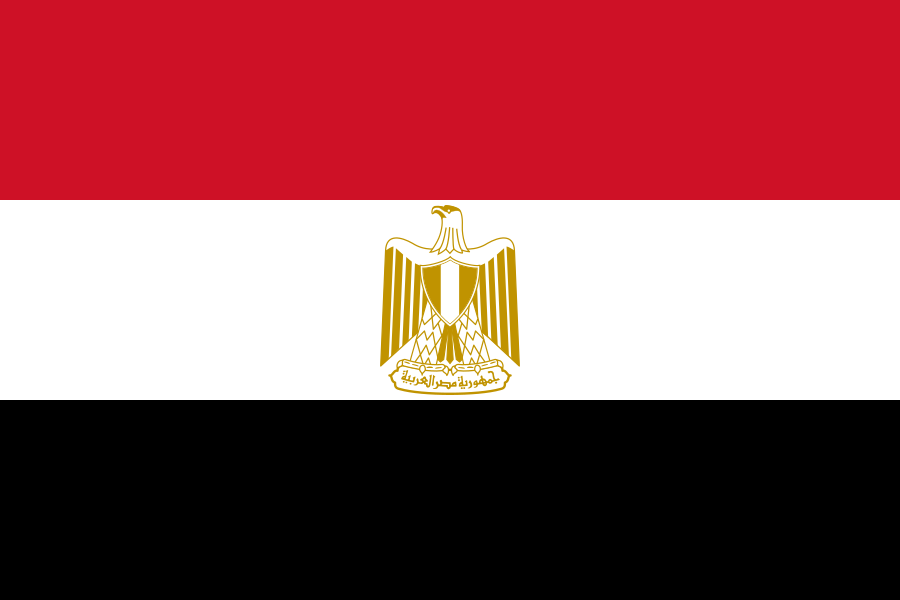
Egypt's flag has three horizontal stripes, red, white and black, with a golden eagle, the Eagle of Saladin, in the middle of the white stripe.
Read about this flag →Egypt at a glance
- Capital
- Cairo
- Continent
- Africa
- Area
- 1,002,450 km²
- Population
- 116.5 million
Egypt is a country in the northeast corner of Africa, with the Sinai Peninsula reaching into Asia. It has coasts on the Mediterranean Sea and the Red Sea, and the River Nile flows through it from south to north. Its capital is Cairo, the largest city in the Arab world, and more than 100 million people live in Egypt. It is famous for the pyramids, pharaohs, mummies and one of the oldest civilisations on Earth.
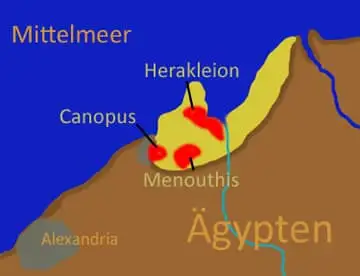
On My Earth Toy Egypt has many landmarks, including the Pyramids of Giza, the Abu Simbel temples, the Valley of the Kings, the Suez Canal and the Step Pyramid of Djoser. Look for the Nile crocodile too, and for the sunken city of Thonis-Heracleion, found under the sea.
Geography and nature
Most of Egypt is desert, part of the Sahara, with only a few oases. The Nile changes everything: almost all Egyptians live in its narrow green valley or in the wide, fertile delta where it meets the Mediterranean. The Aswan High Dam, finished in 1970, holds back Lake Nasser, one of the largest artificial lakes in the world. The Red Sea coast has spectacular coral reefs, and the Sinai has rugged mountains.
People, languages and culture
Arabic is the official language, and most Egyptians are Muslim, with a large Coptic Christian community, one of the oldest Christian churches. Cairo is a huge, busy city of mosques, markets and traffic. Koshari, a mix of rice, lentils, pasta and spicy tomato sauce, is a popular street food. Football is hugely popular. Egyptian films and songs have long been loved across the Arab world.
History in a nutshell
Around 3100 BC Upper and Lower Egypt were united under the first pharaohs. Over the next 3,000 years they built pyramids, temples and tombs, and wrote in hieroglyphs. Later Egypt was ruled by Persians, Alexander the Great and the Ptolemies, including Cleopatra, then by Rome. Arab armies brought Islam in the 600s. After centuries of Ottoman and then British influence, Egypt became independent in 1922 and a republic in 1953.
Fun facts
- The Great Pyramid of Giza was the tallest human-made structure in the world for more than 3,800 years.
- The temples of Abu Simbel were cut into pieces and moved to higher ground in the 1960s to save them from Lake Nasser.
- The Rosetta Stone, found in Egypt in 1799, helped scholars learn to read hieroglyphs.
- The Suez Canal, opened in 1869, lets ships sail between Europe and Asia without going around Africa.
Famous landmarks in Egypt
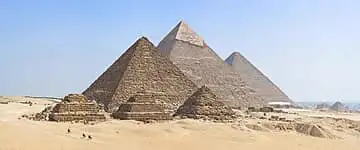
Pyramids of Giza
Egypt · Africa
Monumental royal tombs of Old Kingdom pharaohs; the Great Pyramid is the only Ancient Wonder still standing.
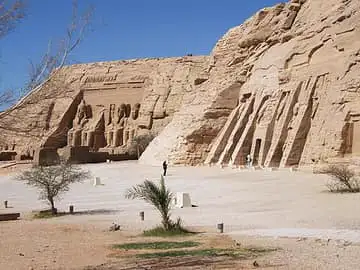
Abu Simbel Temples
Egypt · Africa
Rock-cut temples of Ramesses II fronted by four colossal statues, relocated whole to escape a dam's lake.
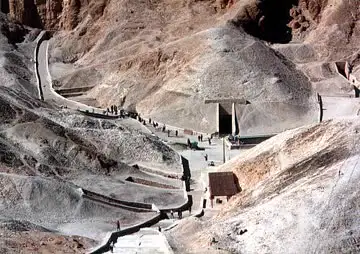
Valley of the Kings
Egypt · Africa
A desert valley holding over 60 rock-cut tombs of New Kingdom pharaohs, including Tutankhamun's.
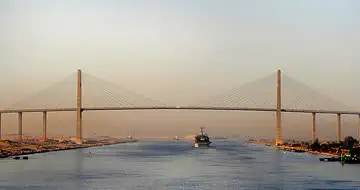
Suez Canal
Egypt · Africa
A 193 km sea-level canal linking the Mediterranean and the Red Sea; opened in 1869, it lets ships sail between Europe and Asia without rounding Africa.
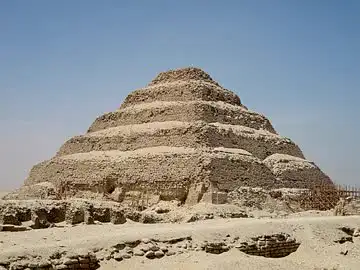
Step Pyramid of Djoser
Egypt · Africa
Imhotep's six-stepped pyramid, the earliest colossal stone building in Egypt.
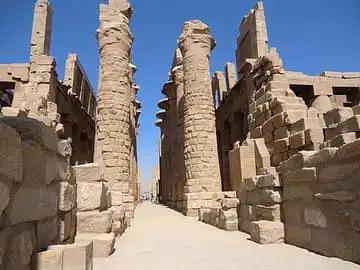
Karnak Temple
Egypt · Africa
A vast temple complex expanded over two millennia, famed for its Great Hypostyle Hall of 134 columns.
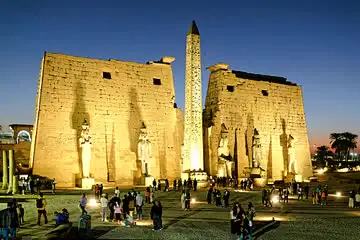
Luxor Temple
Egypt · Africa
A Nile-side temple fronted by a pylon with an obelisk and colossi of Ramesses II, famed for Amenhotep III's great colonnade.
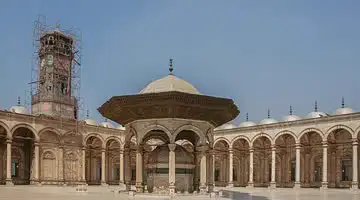
Citadel of Saladin & Muhammad Ali Mosque
Egypt · Africa
Saladin's hilltop fortress, crowned by the Ottoman-style Mosque of Muhammad Ali with its twin pencil minarets.
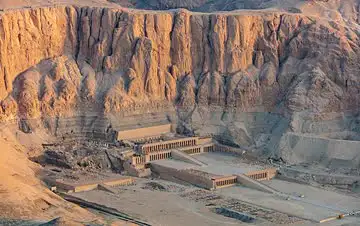
Temple of Hatshepsut
Egypt · Africa
Female pharaoh Hatshepsut's mortuary temple, three colonnaded terraces set against the cliffs of Deir el-Bahari.
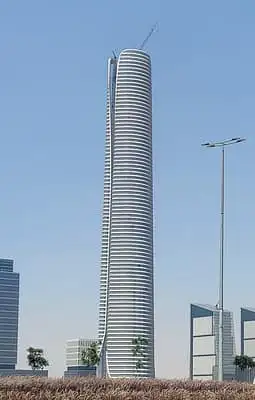
Iconic Tower
Egypt · Africa
Africa's tallest building at 394 m, the centrepiece of the Central Business District of Egypt's New Administrative Capital east of Cairo, completed in 2024.
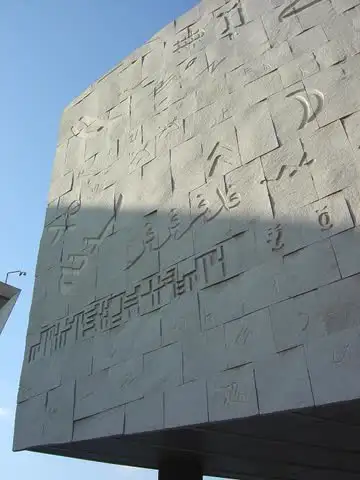
Bibliotheca Alexandrina
Egypt · Africa
A modern library honouring the ancient Library of Alexandria, its huge tilted disc roof sloping toward the sea.
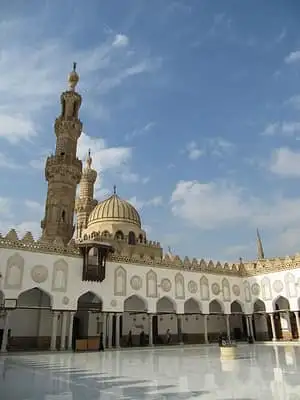
Al-Azhar Mosque
Egypt · Africa
Founded in 970–972 as the congregational mosque of the Fatimid capital and home of one of the world's oldest universities, Al-Azhar grew over a millennium around its marble courtyard and keel-arched arcades.
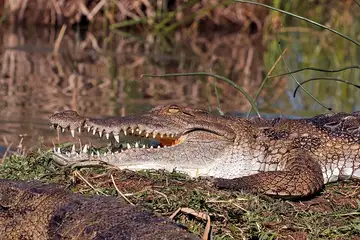
Animals in Egypt
Places to discover in Egypt
Questions
What is the capital of Egypt?
The capital of Egypt is Cairo.
Which continent is Egypt in?
Egypt is in Africa.
How big is Egypt?
Egypt covers about 1,002,450 km².
How many people live in Egypt?
About 116.5 million people live in Egypt.
What are the most famous landmarks in Egypt?
Some of the best-known landmarks in Egypt are Pyramids of Giza, Abu Simbel Temples, Valley of the Kings, Suez Canal and Step Pyramid of Djoser. My Earth Toy has 12 landmarks from Egypt on its free 3D globe, each with a photo and quick facts.
Which animals can you find in Egypt on My Earth Toy?
On the globe you can find Nile crocodile in Egypt.
Sources
Updated: 2026-10-30